April 9, 1964
The individual plant of Waldo rock-cress, although one of prettiest of our wild flowers, is not as conspicuous as some. But when the plants grow in close cluster, which they often do, they form one of the most attractive displays in our wildplant community, and as a border plant would be a decorative addition to any home flower garden. If you have not already made their acquaintance, you have a pleasing experience to look forward to when you visit that most accessible wildflower garden, Rough and Ready State Park, in the spring and early summer.
The sepals as well as the petals of Waldo rock-cress are a beautiful dark rose-purple and as in all members of the mustard family, they are in sets of four. The petals are one-half inch or more long, more than twice as long as the sepals. The flowers are in a short terminal cluster, not many to a single plant. The plant is somewhat hairy, usually six or eight inches high. There are a few narrow leaves but most of the leaves are in a rosette at the base of the flower stem, rather narrow, broadest at the outer end and sometimes with a few short teeth. They are an inch or more long.
Prettiest of the several wild violets of our area is the little pansy-like Hall’s violet. One of its common names is Oregon pansy, in allusion to the much larger and more flamboyant garden flower of somewhat similar appearance. Because of the distinctive and contrasting colors of its petals, Hall’s violet is easily distinguished from any other member of the species in the Valley, most of which have yellow flowers, the dog violet being all-blue.
Hall’s violet is usually three or four inches high, the flower stem extending some distance above the leaves and bearing a single flower which is about a half-inch across. There are five conspicuous petals and five sepals. The two upper petals are a very dark purple or violet; the other three are cream colored. The lower petal is the largest of the five, with purple stripes and a short spur at the base. The two lateral petals have a patch of hair on the inside of the base. The leaves are smooth and divided into a number of narrow lobes. The green of the leaves is usually overlaid with a whitish bloom.
An interesting fact about violets, that is kept secret from the most careful but uninitiated observer, is that they produce another kind of flower on the same plant with the showy blossoms just described. They are produced later in the season, have no petals, and open only to release the seeds. They are self-fertilizing and usually produce more seeds than the earlier flowers.
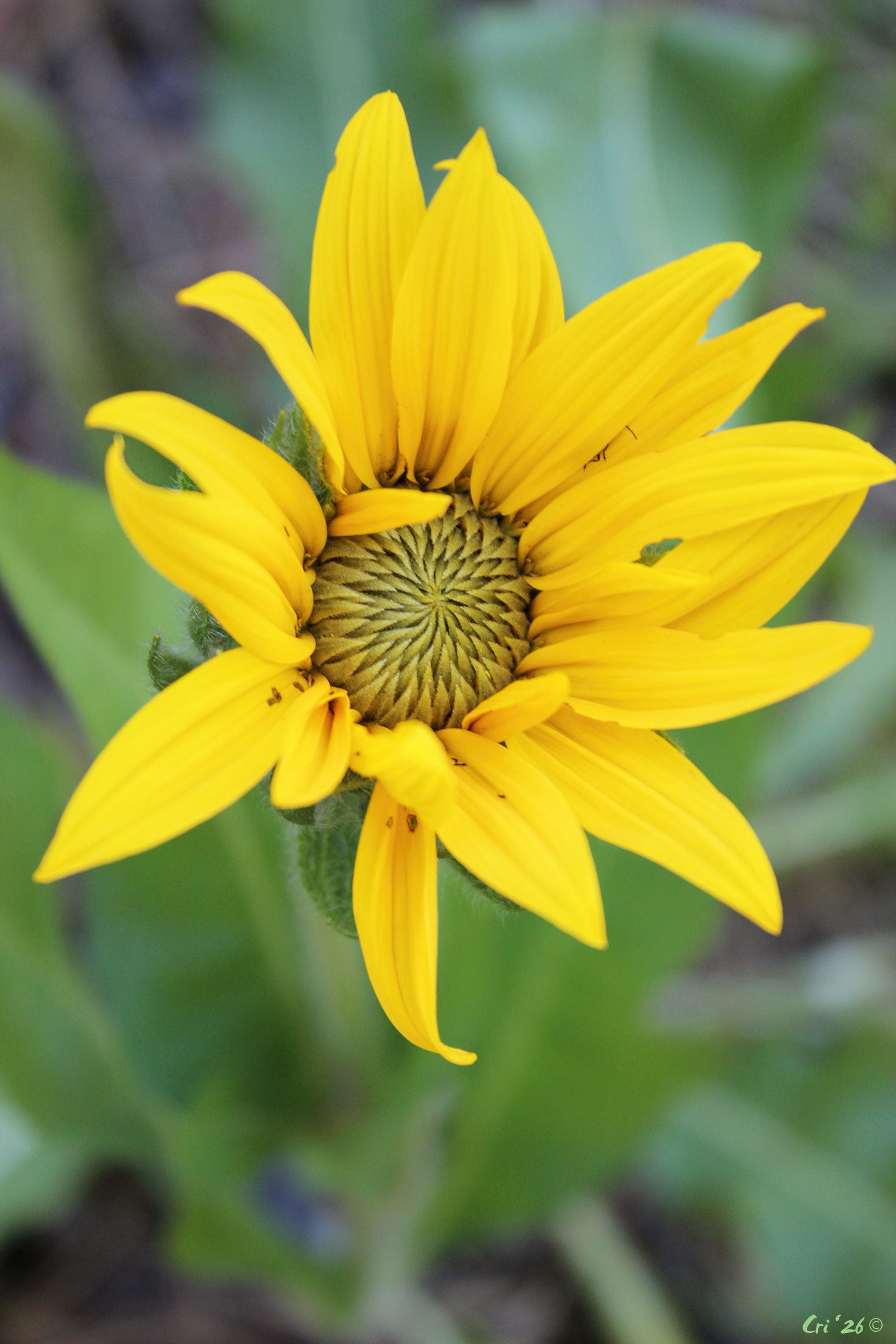
An attractive plant you’ll find growing on Rough and Ready, with large yellow flower-heads and broad green leaves is Norwest balsamroot, so called because of the large glandular roots, characteristic of this genus, that exude drops of a sticky resin-like substance. The plant belongs to the sunflower family and, as in all members of this family; the relatively small flowers are collected together in a flower-head that resembles a single large blossom. In the balsamroot flower-head there are two kinds of flowers; the outermost, or ray-flowers, resembling petals, the remainder in an inconspicuous central cluster.
The showy flower-heads of balsamroot are two or three inches across, usually one or a few heads borne on a stem that may be fifteen or twenty inches tall or more. There are a few small leaves on the stem but most of the leaves spring from the plant base. These are very large, usually heart-shaped and very broad at base, on leaf stems about as long as the blades. They are a little sticky and rough-hairy. The whole plant is somewhat glandular.