By Christy Solo – ONPA 1st Place Award Winner for Best Local Column
This week we’re going to revisit a crawly we met briefly 10 years ago. Reacquaint yourself with the ranchman’s tiger moth (Arctia virginalis).
Why the redux? Well, just look at them! These pretty flitters deserve a more in-depth meet and greet. Moreover, we’ve acquired new photos of a ranchman’s caterpillar and…wait for it…even video!
But wait, there’s more! A new 40-year study on the ebb and flow of the population of ranchman’s was just published so there’s no better time than now for Ranchman’s 2.0.
What’s in a name? Honestly, when it comes to ranchman’s, we don’t know. One would think it’s because they are found on ranches, but in fact, they are not. They could be, but they are more of a riparian moth than a wide-open-ranchland moth. Go figure.
We suppose the upside to the confusing common name is that you don’t have to own a ranch to find one in your yard. You do, however need to live close to water – which basically we all do, so that’s a win for us.
Our pictured adult and pillar ranchman’s were found in the literal riparian zone and where Oregon ash are present. Oregon ash isn’t a requirement for ranchman’s, but they do tend to be found in areas where it grows.
Ranchman’s are generalist feeders, dining on many kinds of herbaceous vegetation, so their fuzzy pillars may pop up anywhere.
Ranchman’s are described as having “spotty” populations (to go with those spotty wings!) Though there can be large populations locally (we’ll get to what causes population increases in a bit). The odds of seeing one are best described as “catch as catch can.” We went 10 years in between sightings.
Luckily, when they are around, they are very easy to see. They are large (one-inch) moths and their bold colors and patterns stand out against greenery.
Also they are day flying moths, so you can see them as they flit about from flower to flower. The best time to see adult ranchman’s is in May and June.
Fun fact: While ranchman’s upper wings are always black with cream-colored spots, their underwings technically have an orange base with black spots. Those black “spots” can be…just that, a few spots, or they can be so big (as in our pictured moth) it appears that black is the base color and the orange is the spot color.
Their heads are always orange and their bodies are black on top, but their bellies are that cheery bright orange with black horizontal stripes.

While adult ranchman’s have color variations, their pillars do not.
You may recall meeting “wooly bear” caterpillars back in Crawlies in 2022. Wooly bears are the black and orange pillars of the Isabella Tiger Moth (Pyrrharctia Isabella) and while they have orange heads and tails with black in the middle, the size of that black band can change significantly making woolies more black than orange or vice versa.
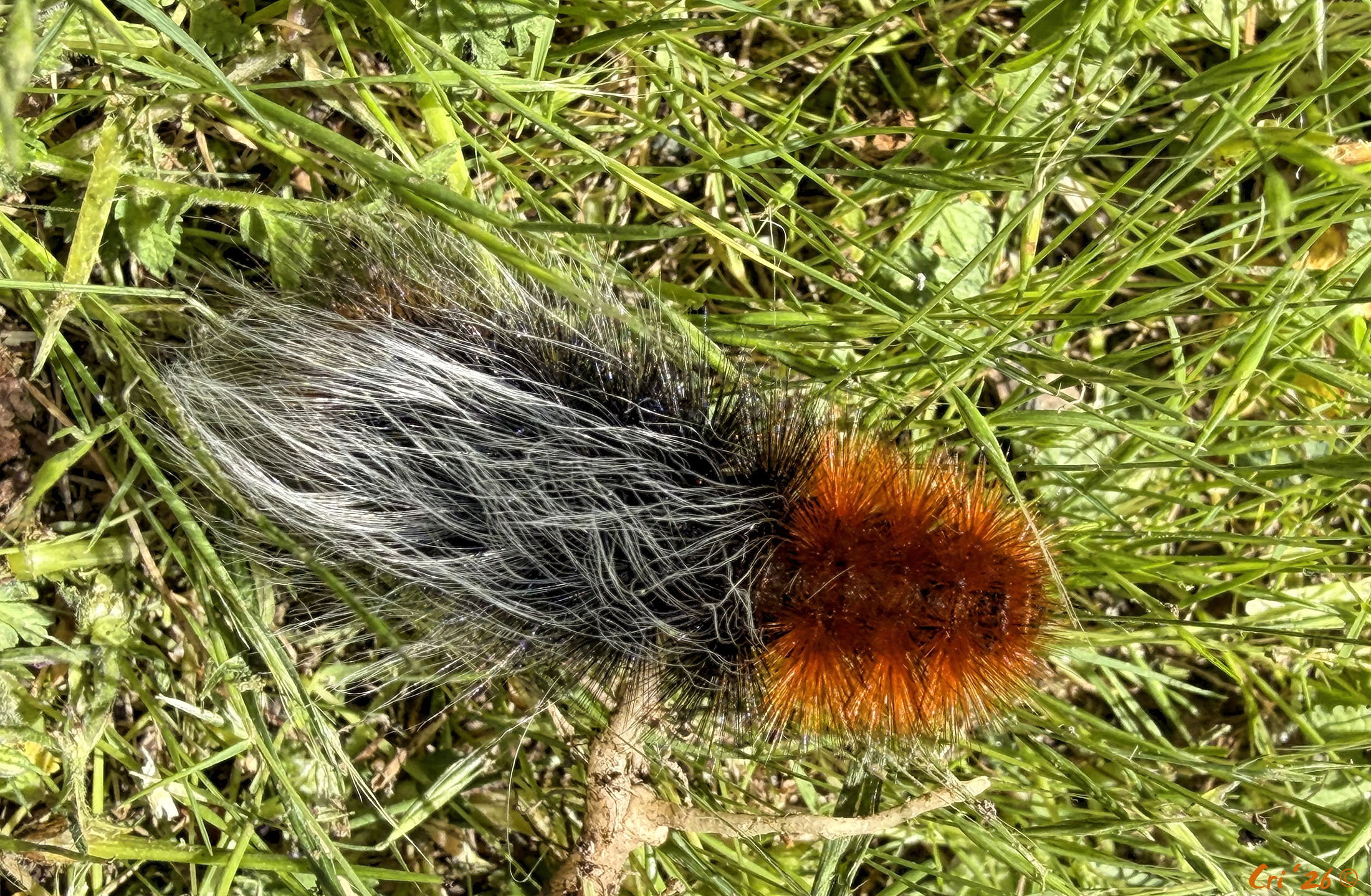
Ranchman’s always have the same amount of orange and black, they ramp up the fancy with the addition of those longer silky white hairs which really add another dimension visually when they motor along on the ground. Possibly those white hairs help to confuse would be predators along with the black and orange “Danger!” coloration.
It’s all for show though, ranchman’s pillars do not have stinging hairs despite their slightly porcupine-ish look.
While there are (obviously) some ranchman’s crawling around this year, soon to be on the wing, this is not the best year to spot one.
Why? UC Davis Distinguished Professor Emeritus Rick Karban just finished a 40-year study (not a typo!) on ranchman’s at University of California Bodega Marine Reserve. He found that ranchman’s need very wet years to have population booms. This year was not that. Moreover in wet and dry years alike, they are found in wet areas, they are not fans of arid landscapes.
It stands to reason that a riparian-loving moth would thrive following a wet winter. Rain helps our pollinating pals, the ranchman’s, in various ways according to Karban, “directly (e.g., reducing mortality of small caterpillars caused by desiccation) and indirect effects (e.g., allowing small caterpillars to escape predation by ants, providing more and better food for caterpillars).”
Of course when it comes to ranchman’s “boom” is doing a bit of heavy lifting. Recall, they are overall uncommon moths.
There are 616 recorded sightings of ranchman’s in Oregon. The bulk of those are along the west side of the Cascades, so if anyone is going to see one – it will be one of us!