By Christy Solo – ONPA 1st Place Award Winner for Best Local Column
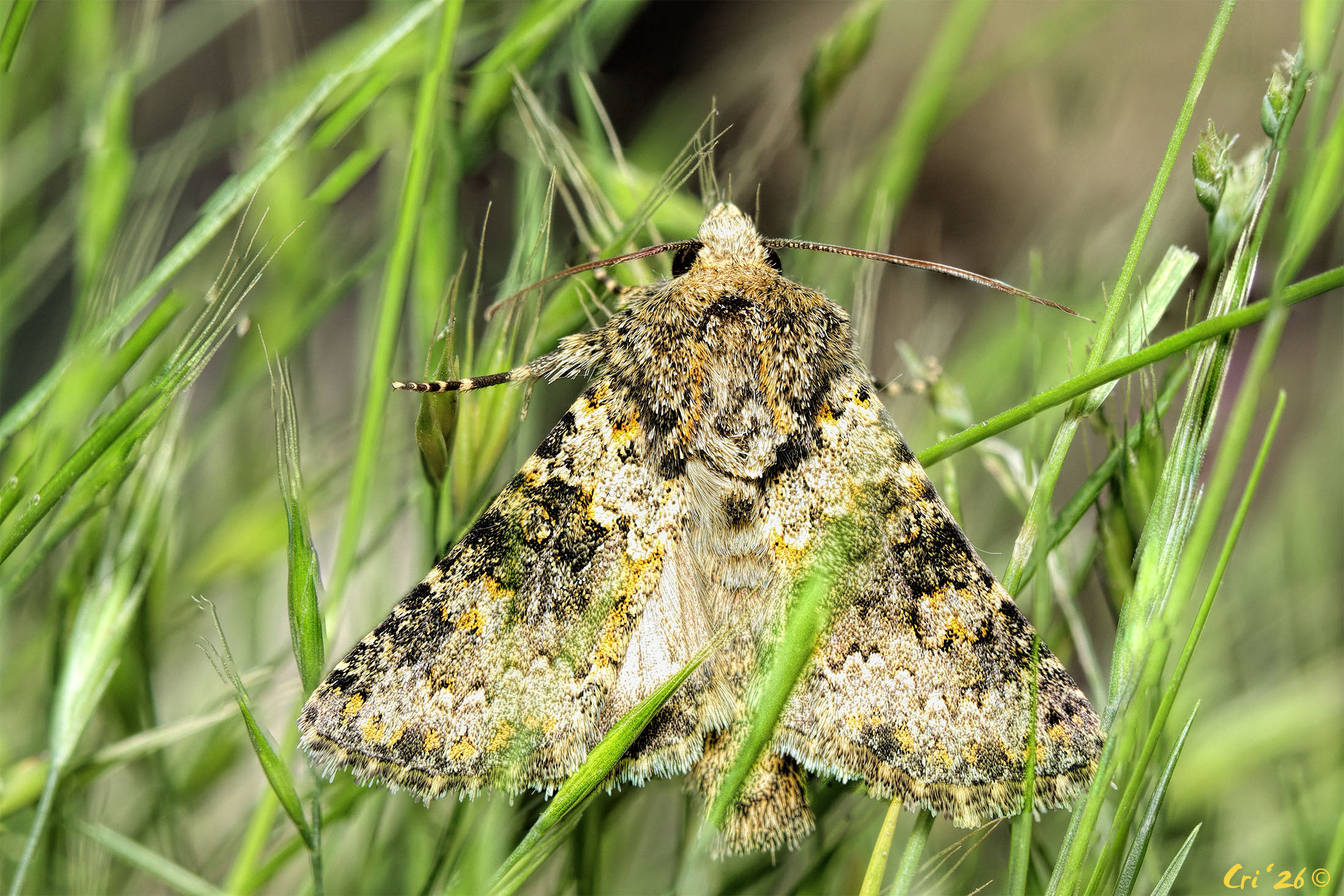
This week we’ll meet a pretty flitter who is a fairly new resident of Oregon. Meet the small ranunculus moth (Hecatera dysodea). We’ll call them “ranu” for brevity’s sake.
What’s in a name? We’ll be honest here, neither the common nor binomial names of this moth make much sense.
Let’s break it all down, starting with the binomial. The genus name “Hecatera” is for the Goddess Hecate who has several associations – dogs, snakes, crossroads, keys, lions, knives and a few more. None bring to mind moths particularly. It is cool to be named after a Goddess, but that’s about it.
Then the species name, “dysodea” is from the Greek dysodia/dusodia which means “ill-smelling” or “disagreeable odor.” However, nowhere in any description of ranus are they described as having any particular odor – let alone a disagreeable one.
Ranus were given their binomial in 1775, so they “why” of it all shall remain a mystery.
As to the common name; the “small” part makes sense because there is, in fact, a “Large ranunculus moth” which is in a completely different Genus but looks passingly similar.
This brings us to the “ranunculus” part of the common name. Ranunculus is most commonly associated with flowers as it’s a Genus in the Buttercup Family.
The origin of ranunculus comes from the Latin for “tadpole.”
Ranus have no real-life associations with either buttercups or frogs. Oh, and yes, we checked, and the Large Ranunculus have no buttercup-y or froggy associations either.
So, what should ranu’s name be? We’d go for a binomial of Hecatera Lactuca (we can’t change the Genus name, and there’s that whole “it’s cool to be named after a Goddess thing) and a common name of Golden Speckled Lettuce Moth.
If our suggested common name led you to deduce that ranu pillars dine on lettuce, you get a gold star!
However, they are into wild lettuce species such as Willow Lettuce (Lactuca saligna) and Prickly Lettuce (Lactuca serriola) which are in the aster family. This is not to say they would turn down “table salad lettuces” AKA cultivars of Lactuca sativa but if you aren’t growing those in your garden, you have no worries when it comes to ranus.

Let’s back up a bit to the whole “fairly new residents of Oregon” portion of our ranu profile.
Ranus are native to Eurasia and were somehow introduced to Oregon around 2003. There are currently 1,034 iNaturalist recorded sightings of ranus in the United States, so they aren’t exactly taking over. Of those sightings 13% are in Oregon mostly along the west side of the Cascades.
If you’d like to see a ranu up close you have a good chance of doing so because there appears to be a solid population along Hwy. 62 from the Calif. border up to at least Shady Cove.
We also have a lot of wild Prickly Lettuce in our area. It’s a tall plant and true to its common name, it does have prickly leaves. It has little yellow flowers which look like mini dandelions. They turn into teeny dandelion-like puff balls. We also have some Willow lettuce, which looks pretty much like Prickly Lettuce except the leaves are – you guessed it – willow-like.
Ranus have two broods per year, so while adults who overwintered in pupal form are already on the wing the next gen will be out and about and coming to a porch light near you through September.
Final fun fact: Ranus went extinct in England in the late 1900s, but have made a comeback – reappearing across the pond just a few years before they made their debut in Oregon. Currently England has about twice the recorded sightings as Oregon has, which has made them very happy.