by Dr. F. Alice LeDuc
Ceanothus – Ceanothus prostratus – Prostrate Ceanothus, Mahala Mat; C. pumilus – Siskiyou Mat; C. thyrsiflorus – Blueblossom Ceanothus; C. sanguineus – Oregon Tea Tree; C. velutinus – Snowbush, Tobacco Bush; C. cuneatus – Buckbrush; C. integerrimus – Deerbrush
I was so delighted when I could visit Oregon in June. The Ceanothus would be in full bloom. Of course, my favorite one was Bluebloom or California Lilac with its masses of tiny blue flowers covering the dry hillsides. From Northern California north into southern Oregon the hills would be blue, much to my childish delight. There is no more beautiful sight than a hillside covered in blue shrubs. It looked like a blue sky on the slope. There are seven species of Ceanothus that are native to southern Oregon. The first three listed have blue flowers and the last four normally have white flowers.
Over the next two weeks, we’ll learn about both the blue and white species. Let’s look at the blue flowered species first. Of course, my favorite is Ceanothus thyrsiflorus. This is a woody shrub that blooms in mid-spring, normally found on the west side of the Cascades in our area. Often seen as an erect shrub with stems that are green when young and smooth. The leaves are alternate, evergreen, oblong to egg-shaped with 3 veins raised on a light green, hairy leaf underside. The upperside is dark green and shiny, the margins have glands on the teeth. The flowers are normally light to deep blue in dense clusters to three inches wide. The seedpods are sticky.
You can find these plants at lower elevations in woods, coastal bluffs. If you rub the flower clusters together briskly between your hands using water you will get soapsuds. Naturally the fragrant flowers are popular with a number of pollinators including butterflies and bees.
This species has become a very popular landscape plant for more that it’s beauty. It is quite drought tolerant. Actually, after established watering the plants will shorten their lives greatly. In nurseries you can find a number of cultivars some tall to fifteen feet and some short to about three feet.

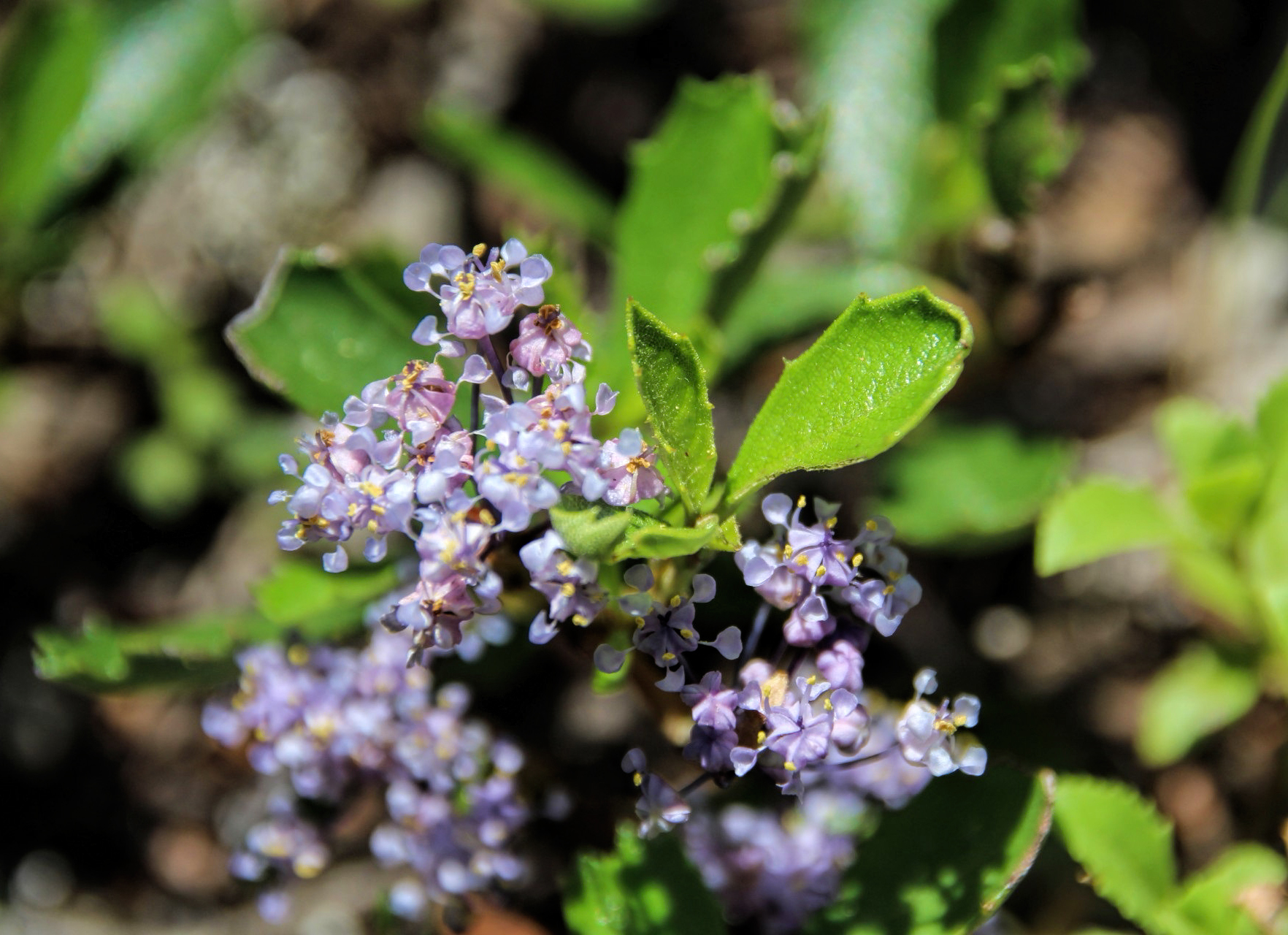
The other two species with blue flowers are low to prostrate growing plants mainly forming mats. They differ from the Blueblossom by having opposite, evergreen leaves, and red to brown stems. Mahala Mat at least tends to root into the ground where the stems come into contact with the soil.
Mahala Mat has oval to oblong leaves, one inch long, leathery with three to nine teeth on the tip end. The top of the leaves is smooth but the underside has hairs on the veins. The flowers are in small clusters, blue, lavender, or white followed by red, round fruits that are wrinkled on top.
The species can be found in the Pacific Northwest from Washington through Oregon, Idaho, Nevada to Northern California. They are found growing in open areas of Conifer forests at mid to high elevations. The most important feature of this plant, especially from a conservation point is their roots are capable of fixing nitrogen. They provide five to thirty percent of nitrogen input to ecosystem. Explanation, nitrogen fixing is important because the roots are able to take elemental nitrogen from the air and convert it to useful forms such as nitrates and ammonium.
The other species, Siskiyou Mat differs in having shorter leaves, less that three quarters of an inch long with few teeth near the tip. Also, the seedpods are rounded not wrinkled on top. This is a rare plant found only on serpentine soils from 100-000 feet elevation., mainly in the Siskiyou Mountains.
Next week we’ll explore the white flowering Ceanothus species.