Crawlies with Cri – California Mortarjoint

By Christy Solo – ONPA 1st Place Award Winner for Best Local Column

Sometimes it’s a long journey from “I found a cool bug!” to “I can actually write a Crawlies about it!”

To date, this week’s crawly represents the longest journey yet. It took me eight years from the first time I saw our featured critter until I was able to ID our featured critter.

Why? First, arthropod ID is hard. I have scads of photos in my files labeled “Unknown” whatever (beetle, wasp, bug, etc.) The ID journey for some of those crawlies may never come to an end.

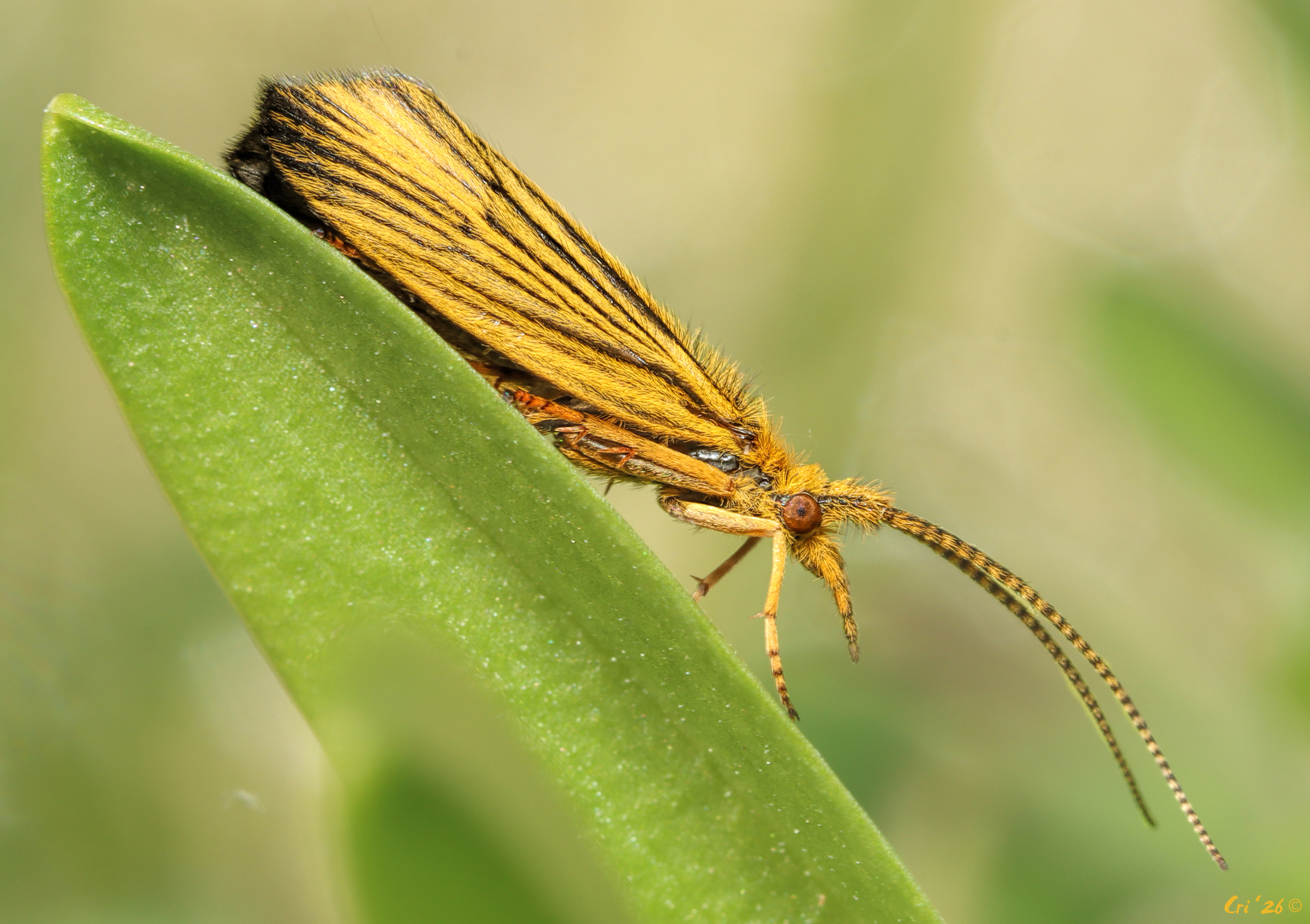
Second – well, let’s meet this week’s crawly officially: Meet the California Mortarjoint Casemaker Caddisfly (Nerophilus californicus). We’ll call them Calicase for short.

macro photo of a fuzzy orange caddisfly with black stripes on their wings. they are on a blade of grass perched in profile facing right and slightly downward.
The original 2018 “mystery” caddisfly – who I finally ID’d as a California Mortarjoint Casemaker Caddisfly (Nerophilus californicus) eight years later almost to the day. Photo by Christy Solo

Wait, what?

Yep. I promise, this orange fuzzy wuzzy is indeed a caddisfly, not a moth. As larvae they live in a stream-fed pond in the Rogue River National Forest. As adults, they hang out on the foliage around the pond.

The calicases’ mothy-ness was the first hitch in my giddyup on the road to ID. Luckily an entomologist/moth/butterfly expert friend quickly deduced our fuzzy friend was a caddisfly.

Fun fact: There are several moths who bear a striking resemblance to this caddisfly, down to color and pattern. I don’t know Who Wore it First.

After scouring BugGuide back in 2018 and coming up empty on any caddisflies that even remotely resembled our calicase caddis and might live in Oregon; I turned to social media.

I posted the 2018 photo out to my 14K followers (many of them entomologists, biologists, naturalists, etc.) and came up with…nothing. No one knew what species they were. No one even had a guess at a genus or family. Goose eggs.

Admittedly, I gave up for a few years but did look for another orange, fuzzy calicase every time I visited the pond where I found the first one. No luck.

In 2024 I once again posted my 2018 photo of our calicase to social media – by then I had thousands more followers, so hoped this time around someone would ID it.

They…did not.

I tried a reverse image search (you upload your photo and the internet finds and shows you visual matches) but only found one similar looking caddisfly who is only found in South America. So…nope. Definitely not our calicase.

So I filed calicase back into my “Unknown Files.”

Then on June 5, 2026 while visiting “Calicase Pond” I hit paydirt! This time I found five fuzzy calicases around the pond’s edge. Looking back, I’d found the 2018 calicase the last week of May, so timing is key.

photo of a fuzzy orange caddisfly with black stripes on their wings. they are on a blade of grass facing the camera.
California Mortarjoint Casemaker Caddisfly (Nerophilus californicus) big name for a fuzzy caddis. Their antennae are also amazing. Photo by ChristySolo

I figured I’d give social media one more go. With my followers now at 65K surely someone would be able to ID this stand-out caddisfly.

They…could not.

So I bravely took another run at BugGuide – after all it had been eight years since my last try – but I had no luck. Stubbornly I then headed for iNaturalist.

In theory, iNaturalist will “ID your critter for you” – I have never used it to get an ID, because: IDing arthropods is hard!

Those who offer IDs on iNat are not necessarily experts, but many non-experts are eager to jump in and give a definitive (definitively wrong) ID nonetheless.

Case in point is our calicase. Let me explain.

Quick note, it’s much more difficult to do your own exploring on iNat – it is organized very differently than BugGuide.

To search on iNat, I had to look at every single photograph of a caddisfly taken in Oregon. That’s 2,574 photos for the record. Wheee!

There is no way to sort the search on iNat if you have no jumping off point beyond “caddisfly.”

On BugGuide you can search “caddisflies in Oregon” month by month, for example. So you are just looking at applicable months. You don’t have to look at fall hatching caddisflies if you found your caddisfly in June. This is still slow, but quicker than scrolling through 2,674 photos.

On the first five pages of photos I did find caddisflies that I was sure were the same species as calicase (calicases being a very, very unique looking caddisfly).

All three were spectacularly miss-ID’d with Big Confidence from iNat’s amateur ID-ers.

For example, one person identified a calicase caddis as an October Caddis. October Caddis 1. Are brown, not orange 2. Not fuzzy at all 3. Are three-times the size of calicase.

It was not looking like iNat was going to be the ID Lottery Winner. But I persisted.

Finally on Pg. 20 of “Oregon Caddisflies” photos – someone had correctly ID’d a calicase as…a calicase.

I still went back to BugGuide to verify.

BugGuide ID’s are accurate and agreed with Cali Casemaker as the species so I was able to confirm our mystery caddis’ ID at long last.

BugGuide has three records of calicases. iNat has three (correct) calicase ID’s in Oregon and 63 overall. They do not fall into the “common caddisflies” category.

But they are out there! Per PNW Flyfishing (you want caddis info? Ask a flyfisher!) they like water with sandy soil and the stream-fed pond in the Rogue River NF has that.

Because calicases are uncommon, there isn’t a lot of information out there. We do know that their larvae make those nifty mortar sleeping bag type cases from bits of sand and very, very small pebbles. We also know that their larvae are not opposed to a good aquatic carrion meal. This tracks, as most caddisfly larvae are detritivorous – meaning they feed on dead and decaying matter.

Fun fact: Calicases have varying amounts of orange. Most are similar to our pictured two calicases: “orange with black stripes” but some are very dark appearing to be nearly solid black.

So if you happen to see a fuzzy, orange, one-quarter of an inch “moth” hanging out on streamside or pondside vegetation, congrats! You’ve found the elusive calicase!