A Botanist’s View of Local Flora – False Hellebore

by Dr. F. Alice LeDuc

False Hellebore, Green Corn Lily – Veratrum viride and Californica Corn Lily – V. californicum

This plant has fascinated me for as long as I can remember. Hiking in the subalpine meadows at Huckleberry Gap and those near Rabbit Ears, the large patches of these stately plants, growing up to six feet ,stood out with their large pleated leaves clasping the central stem. I have photographed them from every angle searching for a perfect shot. So, every year that I can get away I seek out the plants and settle down with my camera.  One day I will achieve perfection.

Veratrum viride has an erect stem that is there through the summer with the inflorescence produced in late summer usually in August. It is an herbaceous perennial to six and a half feet high, forming colonies through expansion of distinctive black rhizomes. It is found in the alpine and subalpine areas on both the east and west sides of the Cascades. In wet meadows, forest openings and along stream banks.  The full range extends in eastern North America from Quebec south to Georgia and In the West from Alaska down the western mountainous areas to Northwestern California.

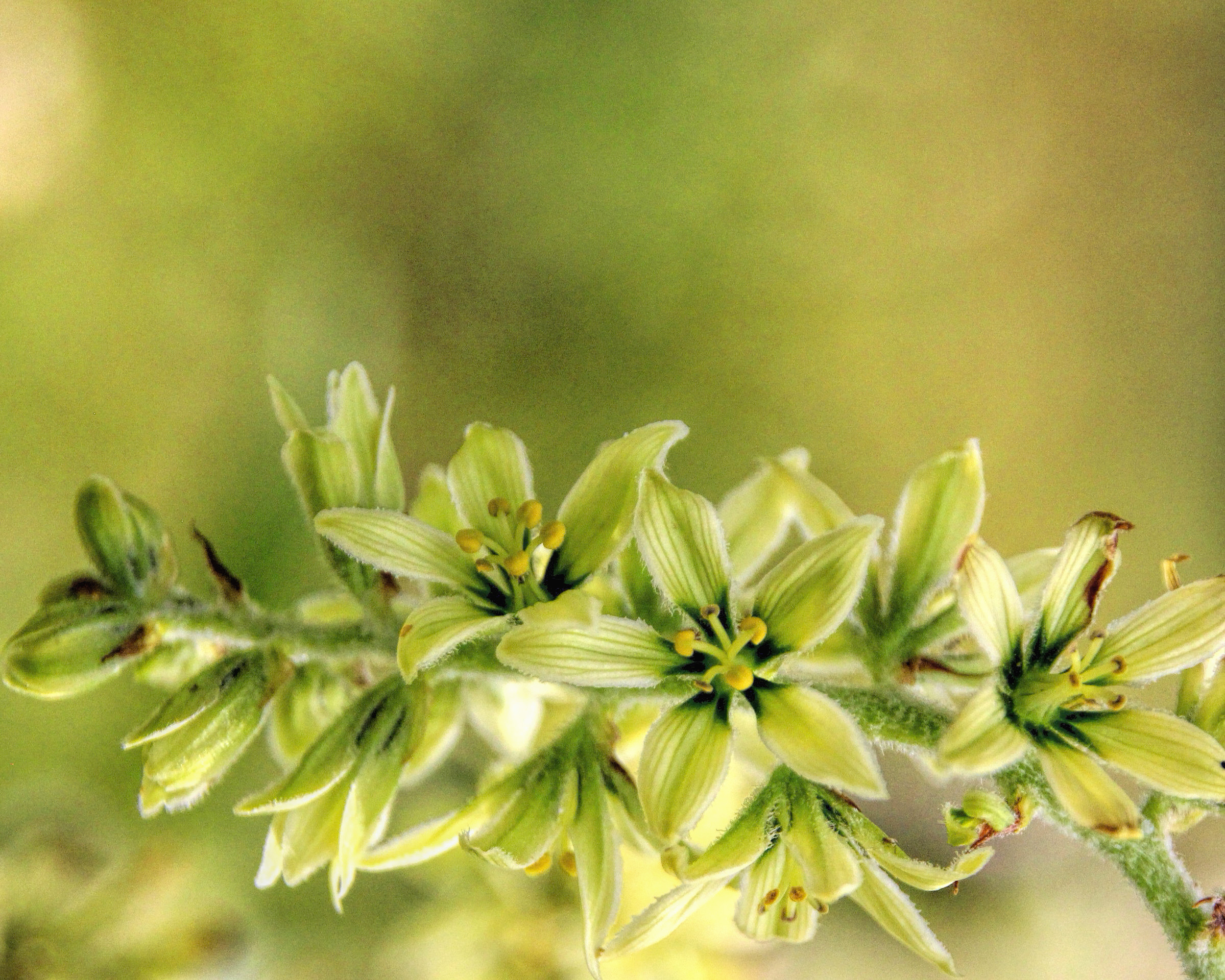
The plants have large leaves four to fourteen inches long and two to eight inches broad with a short point at tip, spiraling up the stem. The leaves have parallel veins raised from the blade surface so that the blade looks pleated or ribbed. The underside is hairy.  The flowers are many borne in large branched inflorescences, of which the side branches are drooping to straight or ascending.  The inflorescences are borne at the terminus of the stems and are 12 to 35 inches tall. The flowers are well spaced each flower has six tepals, green to yellow-green, widely oblong in shape with fringed margins.

photo of false hellebore leaves.
False Hellebore leaves. Photo by Dr. F. Alice LeDuc

The other species of Veratrum is the California Corn Lily quite similar to the False Hellebore. The species is only found in Western North America from Washington south through the mountains to Durango, Mexico. Habitat is wet meadows, stream banks. 

It too is an herbaceous perennial, large erect unbranched stems with large leaves, three to six feet in height, seen on both sides of the mountains.  The leaves are alternate in arrangement that when mature are eight to fifteen inches long, oval with parallel veins, having a few curly hairs on the underside. They resemble corn stalks. The terminal inflorescence on each stem is a dense panicle spreading to upward pointing branches.  Flowers are about one inch wide and clustered on the branched inflorescence.  There are six tepals white with a green center and fringed margins, blooming in July and August.

three up collage of green and white false hellebore AKA corn lilies.
L: Close up of Green Corn Lily flower. R: Full California Corn Lily plant and close up of flowers. Photos by Dr. F. Alice LeDuc

Both species are highly toxic to humans and cattle. The colonies that spread through the meadows can create considerable problems for ranchers. Of great concern are the alkaloids that cause prolonged gestation and birth defects. In humans’ ingestion can cause nausea and vomiting if not expelled can lead to cold sweats and vertigo followed by slowing respiration and lowering blood pressure.  

Despite the toxicity the Indigenous people used California Corn Lily externally for treatment of sores, wounds, burns and rheumatism. The roots have a higher concentration of the toxic alkaloids thus are more toxic.

I hope you will enjoy these strikingly beautiful plants as you explore the wet meadows and forests of the high country.  In addition, Corn Lily can be found in the coastal areas to the midlevel elevations while the False Hellebore is found only at high elevations.