By Christy Solo – ONPA 1st Place Award Winner for Best Local Column
As the weather warms (then cools, then warms, then rains…) you’re most likely beginning to see some wasps about.
What you may not know is that you are seeing way more wasps than you likely realize. Way more.
Fun fact: there between 16,000 and 20,000 species of wasps in the US. Of those only about 50 species are social wasps such as paper wasps and yellow jackets.
Wasps come in every size, shape and color imaginable from the less-than-one-tenth of an inch (1mm), wingless Baeus wasp to the two-inch Cicada killer wasp, found only in the Eastern US.
We’ve all heard about “save the bees” but there aren’t 16K wasp species in existence for nothing! All 16K have their own niche to fill from pollinators to parasitisers they keep our gardens growing and pests under control.
Fun fact: Very nearly every species of wasp is at the least an “incidental pollinator” because nearly all adult wasps drink nectar. When wasps kill other arthropods, they do so to feed their young while the adults zip around full of sugar water.
At-a-glance many wasps appear to be super sleek – but even yellowjackets are fuzzy when you get a good close look. Wasps are incidental pollinators because as they go from flower to flower for food, they pick up pollen on those tiny, fine hairs and move it along to the next posey.

With so many species of wasps around, you can imagine they’ve been broken down into taxonomic categories so we can keep track of them and learn about them.
There are three major wasp categories: Symphyta, Parisitoid and Stinging Wasps.
To be fair, wasps outside of the “stinging wasp” category can sting. But…
….Don’t panic! Most just don’t. Not unless mishandled, or – say – caught in your shirt sleeve and pressed against your skin.
But let’s face it, wasps are basically sugar powered killing machines. All of them. It’s what they do and we’re much better off for it. So for most species, having a venomous sting (to a greater or lesser potency) is key.
The “stingiest” of wasps are our social wasps. Really one type of social wasp – yellowjackets. Like honeybees, social wasps sting not just to protect themselves as individuals, but to protect the hive. Those hives are full of their babies and most of us would sting (if we could!) a giant “intruder” coming toward our home if that intruder could smash our home to splinters with one blow (shades of Jack and the Giant!)
Paper wasps will sting, but you basically have to accidentally touch their nest before they take on a defense beyond “looking at you with great suspicion.” Yellowjackets are tetchier and it’s best to keep 15 or more feet away.
That said, without social wasps we’d be overrun with hungry, hungry caterpillars and our gardens would be laid to waste. Best to just give them space and let them do their thing.

Really, though, it’s those thousands and thousands and thousands of other species of wasps who keep the world spinning as it were, they just do so relatively unnoticed because they don’t build nests over our backdoors.
The largest group of wasps is the parisitoids. This group is made up of seven subfamilies and the families, genera and species just grow out exponentially from there.
Two of the better-known subfamilies are chalcids and ichneumons.
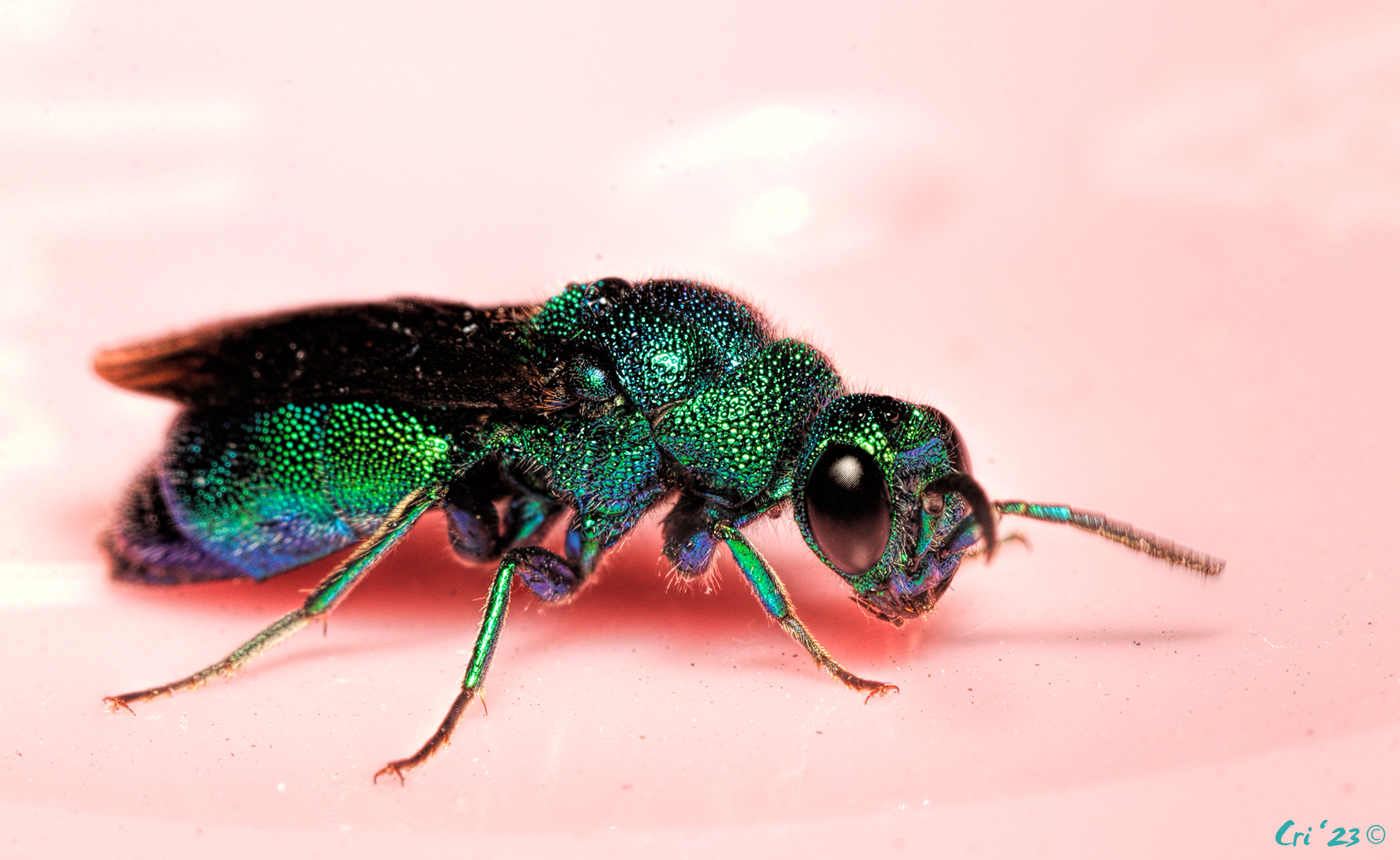
The 2,000 species of chalcids are teeny (1-4mm) and on the whole very pretty, sparkly wasps. Of course you need at least a magnifying glass to see them, but they’re worth looking at.
Chalcids parasitize – well, pretty much any and all other arthropods. While social wasps go in for soft-bodied insects, chalcids keep down the populations of true bugs, beetles and even spiders. These tiny wasps most often lay their eggs inside the eggs of other arthropods, so the larvae of the hosts never even hatch.

Ichneumon wasps also number in the thousands of species and parasitize a wide variety of “pest” insects. Icneumon really keep beetle numbers under control. Ichneumon are so good at what they do they are often used for bio control for agriculture and forestry.
Many other wasps are “food specialists.” The entire Subfamily Pemphredoninae parasitize only aphids, thrips and leafhoppers.
Grass-carrying wasps keep down the population of grasshoppers and katydids.
If there’s a niche, there’s a wasp to fill it.
Imagine how many critters 16,000 species of wasps keep under control, yet we still have plenty of those critters around. Without wasps, we’d be neck deep in caterpillars, true bugs, boring beetles, termites, etc. and plants with no leaves left, if they grew at all because root-eating arthros would get a lot of them.
Wasps are also amazing architects. Paper wasps and some yellowjackets build their elaborate nests with chewed up bits of wood and/or paper. Mud dauber and potter wasps build beautiful, cylindrical nests out of mud they carry to their nesting site one mouthful at a time. Some wasp nests are so pretty, artists use them for jewelry or painting. Making canvass from paper nests or casting rings and necklaces from mud or clay nests.
While some wasps can be annoying at your summer Bar-b-que most wasps go unnoticed while they are making our yards, forests and riparian areas much better places to live or visit, and they come in a variety of gorgeous colors and patterns to boot!