A Botanist’s View of Local Flora – Delphinium

by Dr. F. Alice LeDuc

DelphiniumD. depauperatum, Dwarf Larkspur; D. glaucum, Tall Larkspur; D. menziesii, Menzies Larkspur; D. nuttallianum, Upland Larkspur; D. nuttallii, Nuttall’s Larkspur; D. trolliifolium, Cow-poison

Delphinium is a complex group of plants. So, if you can just recognize the plant as a delphinium, you are ok. Strictly speaking Delphiniums are perennial species and plants which are true larkspur (Consolida) are annuals. However, when it comes to common names the lines get blurry. All of the species I will be discussing in this article are perennials therefore true Delphiniums even though the common names are “Larkspur”.

Perhaps of interest is the derivation of the name delphinium, it’s a Latinization of the Greek word delphinion meaning dolphin. This perhaps comes from the silhouette of the flowers that look like a dolphin. Three species bloom in spring to late spring (D. menzesii, D. nuttallianum, D. trolliifolium) these plants also prefer dryer soils found in open woodlands, meadows and grasslands, though you can find D. menzesii in most meadows. The other three species (D. depauperatum, D. glaucum, D. nuttallii) bloom in summer and prefer moist to wet meadows and open forests. Unique in this group is D. nuttallii which is found in gravely soils like at the bottom of basaltic cliffs. Of all six species one D. trolliifoilium is found only on the westside of Cascades. Three species are short plants ranging between eight to twenty inches in height. The other three species are tall from D. nuttallii at one to two feet to D. glaucum and D. trolliifoilium at two to six feet.

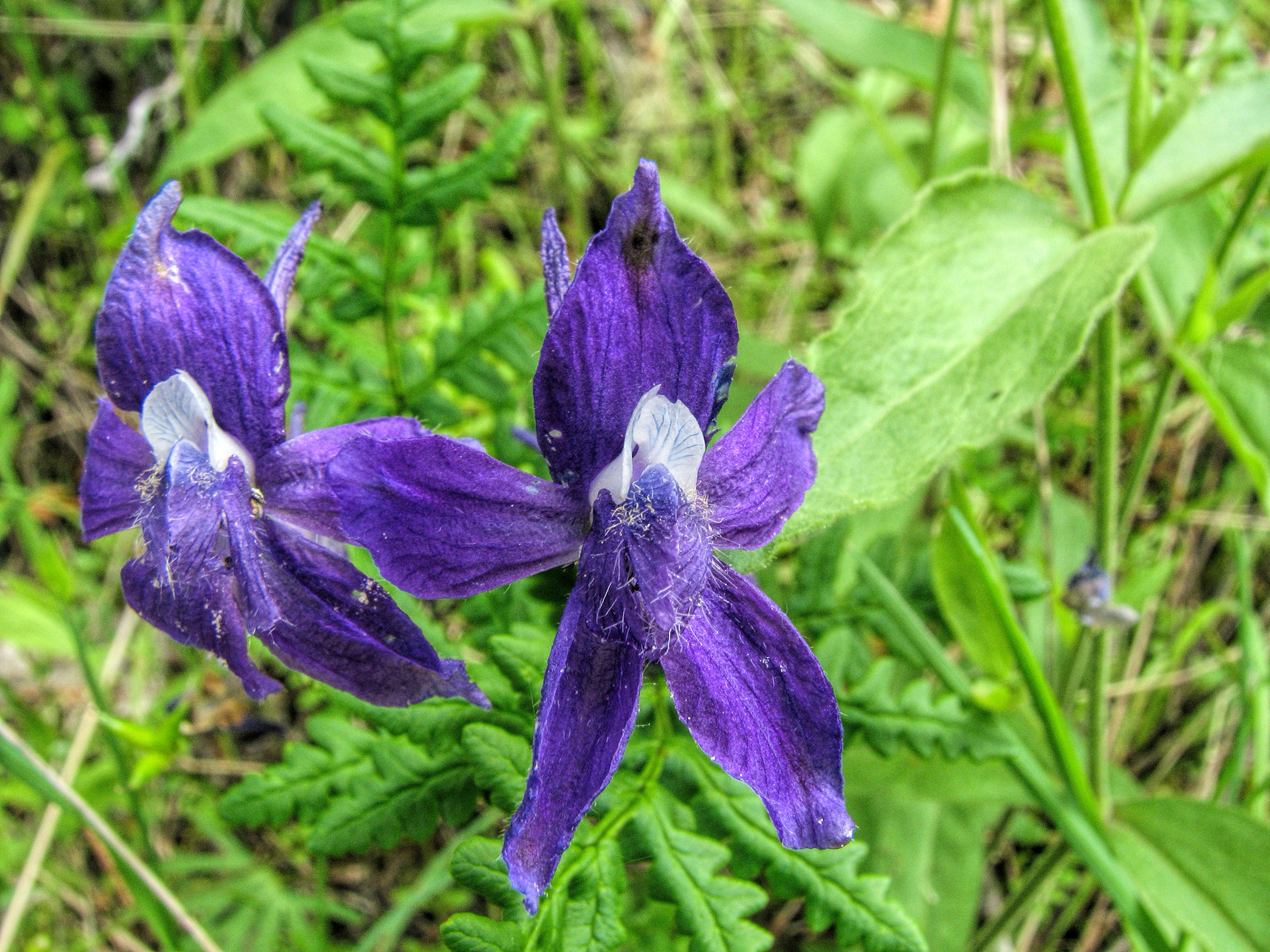
two up collage of violet and purple delphinium menzesii flowers.
Two views of lovely, locally found Delphinium (Delphinium menzesii). Photos by Dr. F. Alice Le Duc

Let’s look at two sets that are often hard to tell apart. The first is Delphinium depauperatum and D. nuttallianum the former in wetter areas and the latter in dryer areas. In many cases they can be found growing in the same meadows. The second set is D. menzesii and D. nuttallii the former has larger and fewer flowers. Also D. nuttallii has flowers bluish and yellowish in different populations. The flowers are pollinated by hummingbirds, butterflies and bees.  Hummingbirds are more active in the spring as they migrate north from Mexico and Central America. I could not locate any research on this species of delphinium but work with Skyrocket showed that the population colors changed to white or pink in late summer as the pollinators changed from hummingbirds to moths.  Could a similar color change be occurring in this species of delphinium as the hummingbirds have migrated south and yellow color is more attractive to butterflies?

Leaves grow in early spring as a basal rosette of foliage. Once the flowering stem develops the number of basal leaves start to disappear. By the time the flowers are blooming Delphinium glaucum and D. trolliifolium have no basal leaves remaining. D. menzesii and D. nuttallii may have one of two to four but most often none. D. depauperatum and D. nuttallianum have at flowering two to six basal leaves. D. nuttallianum has two to ten leaves along stem and D. depauperatum usually has none on the stem but at times could have three. D. glaucum has fifteen to twenty leaves along the floral stem. While D. menzesii, D. nuttallianum and D. nuttallii have two to ten leaves along the stem.

macro photo of a cluster of indigo delphinium flowers.
A cluster of locally found Delphinium flowers. Photo by Dr. F. Alice LeDuc

Flowers are formed with the sepals and petals all petal-like (tepals). One tepal forms into a spur which contains the nectar and the two that are on either side of the stamens are usually white in all but D. trolliifolium. D. depauperatum and D. nuttallii were these tepals could be yellowish. While D. menzesii and D. nuttallii can also have all blue tepals. 

Of significant importance is that all delphiniums are toxic. Particularly to livestock as the plants are found in the same meadows that the animals graze.

There are a number of types of delphiniums found to enhance the gardens. Most of these are not related to our native species. So, enjoy the natives as you wander through the meadows, open woodlands or mountain forests of our area.  While using the more exotic cultivated delphiniums in your garden.