by Dr. F. Alice LeDuc
Salal – Gaultheria shallon – Salal, Shallon and Lemon leaf
Salal is a shrubby evergreen plant related to Manzanita and other members of the Ericaceae Family. The species ranges from Southeastern Alaska south through Washinton, Oregon and into Northern California. Found mainly in the Cascade Mountains to northern California where it stays mainly in the Coastal Mountain Range. It is mainly an understory plant though it will tolerate sunny areas, especially as a restoration plant after fires or other disturbances. The plants prefer a dryer soil under partially to open stands of conifer trees. Though at times they may be found in partial shade especially near moister areas. The plants spread by underground rhizomes forming thickets in the understory.
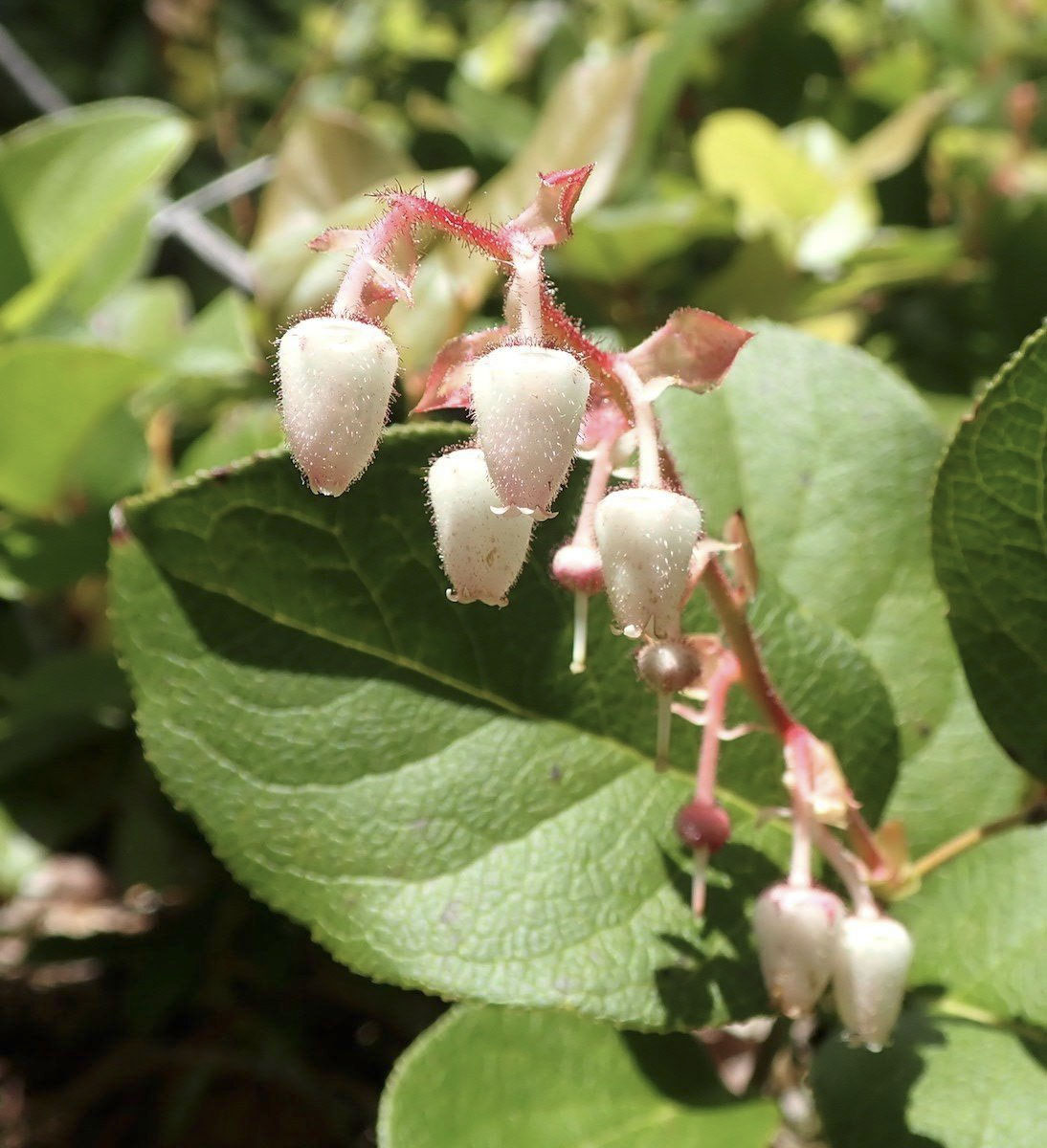
The plant has reddish-brown stems and twigs that last for up to 16 years but retain foliage below the terminal area for only two to four years. The plant leaves are thick leathery roundish or ovate, dark green above lighter green underneath and the margins are finely serrate. Each leaf will persist on the plant for two to four years. The Inflorescences are terminal one-sided racemes baring five to fifteen flowers each. The flowers have united sepals that form a glandular hairy calyx from while hangs an urn shaped five-lobed corolla (united petals). Each flower is pink to pinkish white. The fruit is a pseudoberry. Actually a capsule formed by the calyx fusing to the ovary to form the fruit.

Among other tolerances Salal can tolerate salt spray so does well for stabilizing sand dunes and the sandy bluffs along the Oregon coast. It truly prefers moist sandy to peaty soils They commonly may grow on decomposing logs and humus, even known to be epiphytic (air plants using roots for support and getting all water and nutrients from rain and fog) in really humid areas. Such as, the Olympic Peninsula. Conifer regeneration is usually better where salal is present.
The leaves are browsed by deer and elk mainly in winter when other low vegetation is covered with snow. Unfortunately, the leaves have few nutrients so with a lot of browsing they can suffer from malnutrition. Other animals that may browse on the leaves are beaver, voles and domestic sheep and goats. Several species of birds feed on the fruits, Band-tailed Pigeon, Wrentit and various species of grouse, along with animals like squirrels, chipmunks and black bears.
The flowers are pollinated by hummingbirds, bees and flies. While some animals browse on the flowers. Tin addition, the shrubs provide good cover for birds and small animals.
The important commercial use of Salal leaves is the floral industry. It is one of the most common cut foliage in bouquets and floral arrangements. Other important use for the plants is in restoration after fires. As the rhizomes are underground they often are protected from burning in fires of lower heat.
The fruits have been eaten by Indigenous people, colonists and modern populations. They can serve as an appetite suppressant. They are also often used to make jams and jellies. The medicinal properties have been understood and used by Indigenous peoples throughout the Northwestern U.S.
While Salal has been used successfully in Great Britian in ornamental landscapes. In this country the plants do not do so well in our landscapes. If you are interested it is recommended to purchase plants in containers, wild collected do not transplant well. So, enjoy the plants in the wild, perhaps try a container grown plant in your garden or appreciate the foliage in flower arrangements.