by Dr. F. Alice LeDuc
Lupinus – L. albicaulis – sicklekeeled Lupine; L. albiflrons – White-leafed Lupine; L. argenteus – Silvery Lupine; L. latifolius – Broadleafed Lupine; L. Lepidus var. lepidus – Elegant Lupine; L. lepidus var. lobbii – Dwarf Lupine; L. bicolor – Two-colored Lupine, Miniature Lupine.
Lupines bring back many memories from my childhood. I loved the annual lupines we found on hikes in the canyons below Mount Diablo. In my adult years living in Texas, everyone there has heard of the Texas Bluebonnets aka Lupinus texensis. There are a number of species of lupine found in Oregon. I’ve listed 6 species and a second variety of one of the species. These are all but one species of blue to purplish to white flowered. There are two species with yellow flowers which I am not going to explain in this article. All but the last species listed above are perennials while the last is an annual plant. These species range from Canada through Washington, Oregon, California and some to Mexico. The habitat is mainly meadows or dry ground or Shrub Steppe. With L. argenteus, L. lepidus varieties and L. albicaulis found in the drier locales. Interestingly the annual species L. bicolor is often found in vernal wet meadows.
Lupines are another genus that have challenged botanists through the years. With at times a large number of species and then finding the numerous species combined into much fewer species, only to be split out again. This lumping and splitting is still ongoing. The wise botanists are reporting that the genus structure is extremely complex. They have found inbreeding populations and outbreeding gene flow from cross pollination. More simply there is a lot of variation, question is that just diversity within a species or natural hybridization leading at some point to new species.

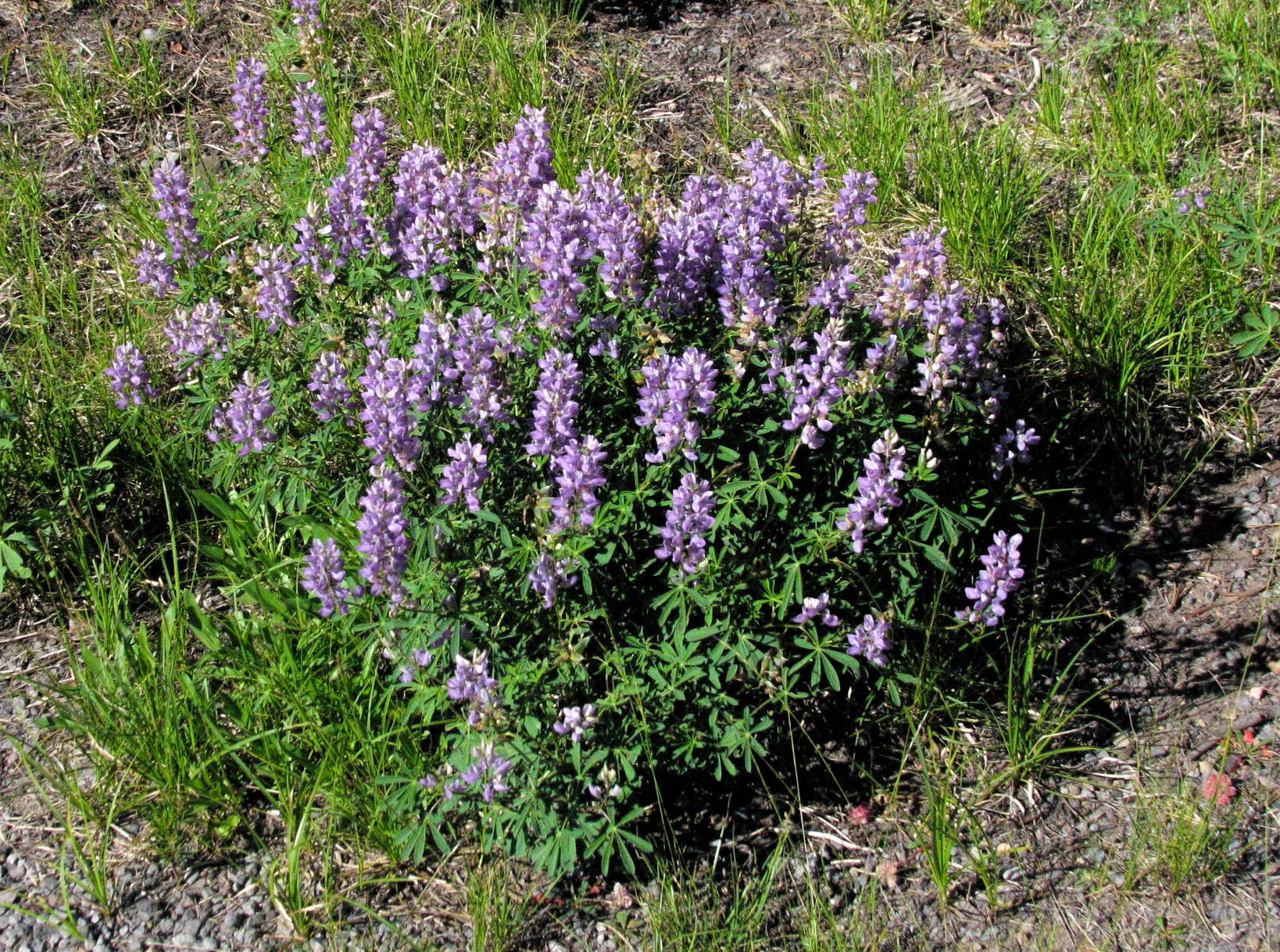
The characteristics to look at to tell the species apart are height of plant, the number of divisions on the deeply palmately lobed leaves, the smoothness or hairiness of the leaves. Finally, the flowers which are papilionaceous or butterfly-like in shape. At the back is the banner that stands erect, at the bottom is a plus or minus fused dual petals that form a keel shape, covering the keel more or less are the middle two petals that are wing-like. (see close-up photo) So in alphabetical order 1. Lupinus albicaulis has a height of one to two feet, the leaves covered with silky hairs, which are divided into five to ten leaflets; the flowers are loosely arranged on the flower spike, dull white, purple or yellow, the keel has an extremely upward curving tip that emerges up through the wing petals. Blooms summer to fall. 2. L. albifrons is an evergreen subshrub, three to five feet tall; leaves silvery, palmately divided into six to ten leaflets with surface hairy; flowers borne on three-to-twelve-inch spikes, pale blue, deep violet or magenta, the banner is usually hairy, keel unlobed with margin toward tip ciliate (long hairs). Blooms spring to early summer. 3. L. argenteus is a perennial herb or subshrub, one half to two and a half feet tall; leaves are palmate with six to nine narrow leaflets and appears silvery because of numerous fine hair; the flowers on a one and a half to twelve inch spike are blue to violet and occasionally lavender, pink or white, the banner has distinctive white or yellow spot that turns red-purple with age. Bloom late spring to summer. 4. L. bicolor is annual herb, leaves palmate with five to seven leaflets; inflorescence a raceme (spike) 3.1 inches tall, flowers two colored deep blue and white with a white spot on banner that changes with maturity to light purple or magenta. Flowers in spring to early summer. 5. L. latifolius is perennial herb one to six feet tall; leaves large, palmate, five to nine leaflets, that are often smooth; inflorescence is a raceme four to twelve inches high, flowers purple, blue or white with a banner spot that is yellowish or white changing to pinkish with age. Blooms late spring to summer. 6a. L. lepidus var. lepidus is a perennial four to twenty-four inches tall; leaves hairy, mostly basal, palmate with five to seven leaflets; inflorescence is a raceme, with pink, blue, purple or white flowers and a yellowish banner spot. They bloom mi- April to August. 6b. L. lepidus var. lobbii is a perennial four to six inches tall; leaves silvery and long petioled, palmate with five to seven leaflets; flower spike erect with blue to purplish flowers with a white spot on the banner. Bloom period is May to September.
By height it is easy to identify Lupinus latifolius which is very tall, and L. lepidus var. lobbii which is very short and found in mats mainly in pumice soil. The one thing to remember about all of the lupines is they are toxic to animals especially cattle. A fun fact is that Lupinus latifolius is the host plant for several butterflies, Clouded and orange Sulphur, Persius Dusky-wing and Silvery Blue.
I hope you get out to check out the beautiful lupines this spring and summer.