May 16, 1968
Some of the most attractive and interesting of our host of parasitic plants are the various members of the broomrape, or cancer-root, family. For those who want to look them up in the wildplant manuals the botanical name of this family is Orobanchaceae. The family is divided into two genera, both represented in our area: Orobanche, the broomrapes, and Boschniakia, the ground cones.
Of the 5 species I have found in this area 4 are broomrapes and one is a ground cone, the only one of the latter found in our vicinity. The most strikingly odd-ball of the group is the ground cone, and to one interested in wildplants, to find them growing in the shady woods is a never-ending treat. I have been acquainted with them for a number of years, and still one of my greatest thrills is to see the first ground cone poking its way up through the forest mold.
The ground cone is very selective in its choice of hosts and derives its nourishment only from the juices of the madroña tree and manzanita shrub. Each plant at maturity bears a multitude of seeds which become scattered by various means and eventually germinate and send root-like processes down into the ground. If the baby parasite is lucky its probing feelers will come in contact with a rootlet of either a madroña or manzanita, to which it becomes attached, penetrating the tender bark and from then on living contentedly at the expense of its congenial host.
If in its hopeful probing the tiny ground cone fails to contact a rootlet of either of the two host plants named, before its stored seedling nourishment is dissipated, it shrivels and dies. Because of its limited choice of host plants this, obviously, is the sad fate of the great majority of the ground cone’s horde of seeds, and, of course, the slim chance each tiny seedling has of hitting the target explains why nature was so generous in providing each mother plant with seeds.
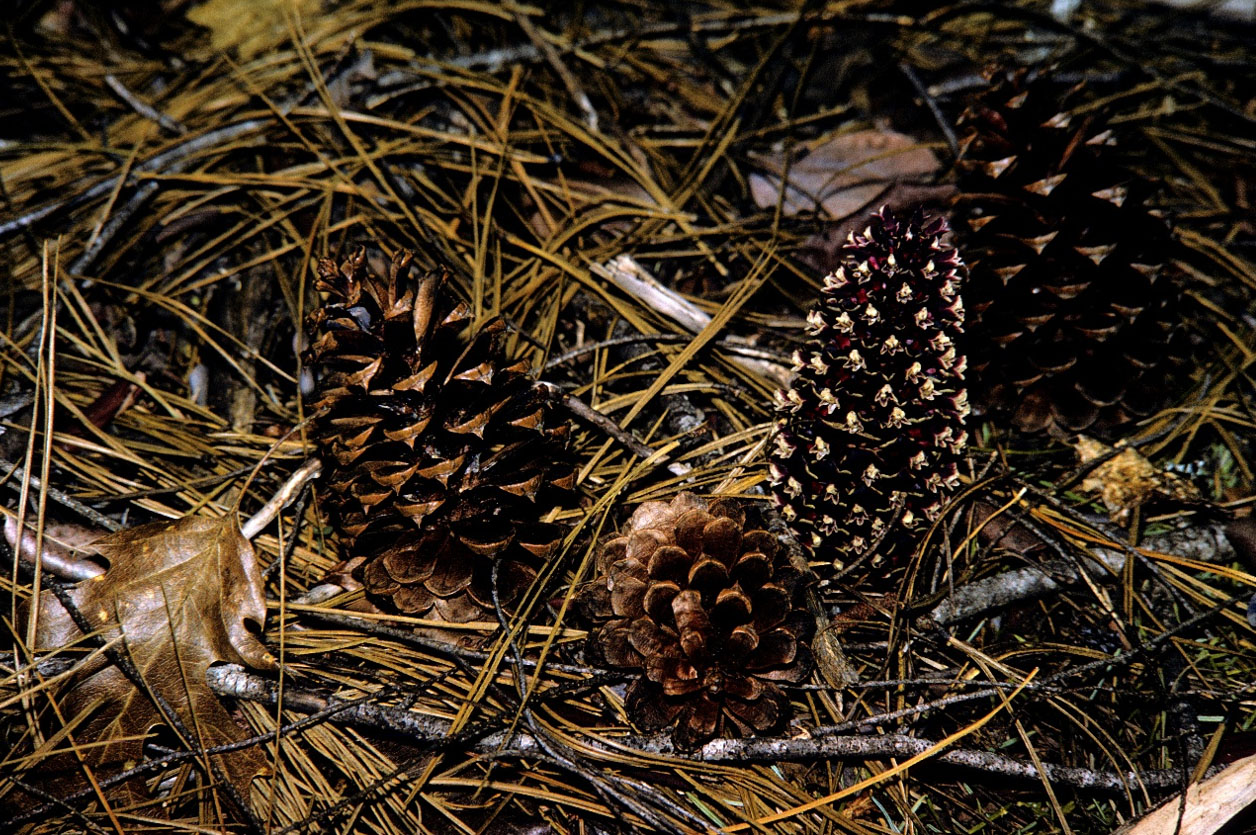
Ground cone is an appropriate common name for this fascinating friendly robber plant, which, if not welcomed by its host, certainly is of no concern to the latter health-wise. When the young pilferer first makes its appearance above ground, having dined well and thrived splendidly at its generous host’s table, it is shaped like a broad pointed bullet. It is clothed in closely overlapping scales (the leaves) which are usually dark purplish with yellowish markings along the edges. Later, as the fast-growing plant pushes above the ground, the leaves spread out slightly from the thick stem.
At flowering time the upper smaller scales spread sharply outward and a short curved tubular flower springs from each axil. The blossom is broadly two-lipped, with 3 lobes on the lower and usually 2 teeth on the upper lip. At this stage the many slightly protruding flowers give to the plant a somewhat fluffy appearance.
As the ground cone matures, the predominant purple or purplish-brown color of the very young plant is often suffused with varying degrees of yellow. Rarely the plant is, from the very beginning, a clear light yellow without a trace of the characteristic purple. I have known of only one spot where this pure yellow strain grows, the host being a large spreading madroña. I was directed to the location by a forest ranger, who thought he had found a new species.

The plant assumes such a variety of startling shapes and purple-yellow variations that it never fails to fascinate and amuse cancer-root watchers. And especially at or near maturity, when its large round seed cases give credibility to its nickname of “bear corn,” it does resemble at first glance a fair-sized pine cone resting in its broad base.