Commentary by Christy Solo
This week’s Rogue is a bit of a follow-up – or follow-on – to previous Rogues and the April 22 All Things “Birds on a Budget.”
In previous Rogues I’ve written about my quest to keep my backyard Band-tailed Pigeons (crow-sized native pigeons) from hoovering up all the bird seed and leaving the little songbirds seedless.
To that end, I purchased several (now six) caged bird feeders in various forms and sizes. Most are platform feeders because birds just love platform feeders. I mean who doesn’t love the easiest meal and platform feeders are large and accessible.
The wire mesh enclosing the caged feeders can vary in size, all of mine have the “big enough for a Black-headed Grosbeak to fit through, too small for pigeons and doves” gauge because that was my personal goal.
The best part (for me, maybe not for everyone who feeds backyard birds) is that pretty much every bird and yard critter can sort out how to get seed out of the caged feeders – except for the pigeons.

Again, because I *only* bought the feeders to slow down the Band-tailed, this is perfect for my needs.
Jays (Steller’s and Scrub) perch on the side and can fit their heads through the mesh for the black-oil seeds. Mammals get very creative, as you can see in the pictures of a raccoon, California ground squirrel and western gray squirrel.
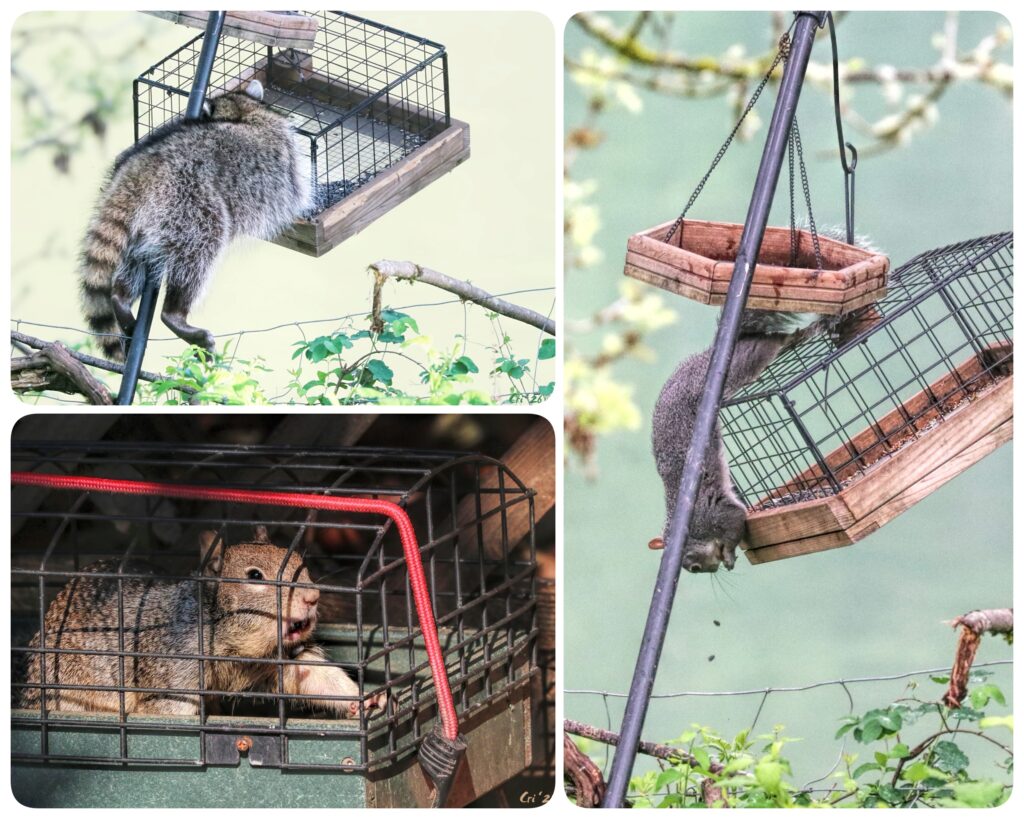
If you’re a mammal anyway. Band-tailed can neither tilt the huge feeder nor fit any part inside the smaller feeders. Photos by Christy Solo
Still, Band-tailed are baffled. They can tilt hopper feeders and get 99% of the seed to spill on the ground, but the hanging, caged feeders are just too well balanced. A squirrel weighs enough to tilt it, bringing the seed to the edge, but not enough to spill the seed out. Same with raccoons, they can tilt the feeder with their little hands but still have to reach in for seeds. Band-tailed just don’t weigh enough (and lack opposable thumbs) so try as they might (and BOY do they try) caged feeders elude them.
All that said, I do fill one feeder – a very small platform – for the Band-tailed but even that is more money than I can afford to spend on these bottomless pits of birds. One small feeder full is just an appetizer for them…no not even that, it’s an amuse bouche.
I’d seen whole kernel dried corn for sale in the wild bird seed aisle (as mentioned in the April 22 All Things) but it was the same price as black-oil, so while I thought *maybe* giant corn nubs would go further toward filling up the pigeons (and would be too big for the small birds, so the pigeons could have it all) – without a cost savings, might as well just keep giving them the cheap mix.
Still, I thought it would be worth trying a small experiment, especially as corn is listed as Band-tailed’s number one “fave food” on the Cornell Project Feederwatch site.
So last week during my weekly Walmart trip, I bought a small bag of black-oil/corn mix. I planned on spreading it on the ground in an area of my yard away from most of the other feeders, maybe I could woo the pigeons to one section (yeah, I’m an optimist).
Because I buy 40+ pounds of birdseed each week, I make two trips through Walmart. It’s no fun hitting the food section with bulky, heavy seed bags in the cart. So, after purchasing and loading up all my seed stores in my car, I hit the pet food aisles. There I saw a new display; 40 lb. bags of cracked corn and whole kernel corn for…wait, what? For a mere $10 for 40 lbs.
I really thought – as the display was new – that the price must be wrong.
Cracked and whole kernel corn was at minimum $20 for 40 lbs. in the bird seed aisle, and often much more (see screen grabs of actual prices from Walmart’s website this week).
So I didn’t load up another bag but opted to first see if the pigeons would even eat the corn and second, if they did then I would check Walmart’s website to see if that whole $10 for 40 was really true.
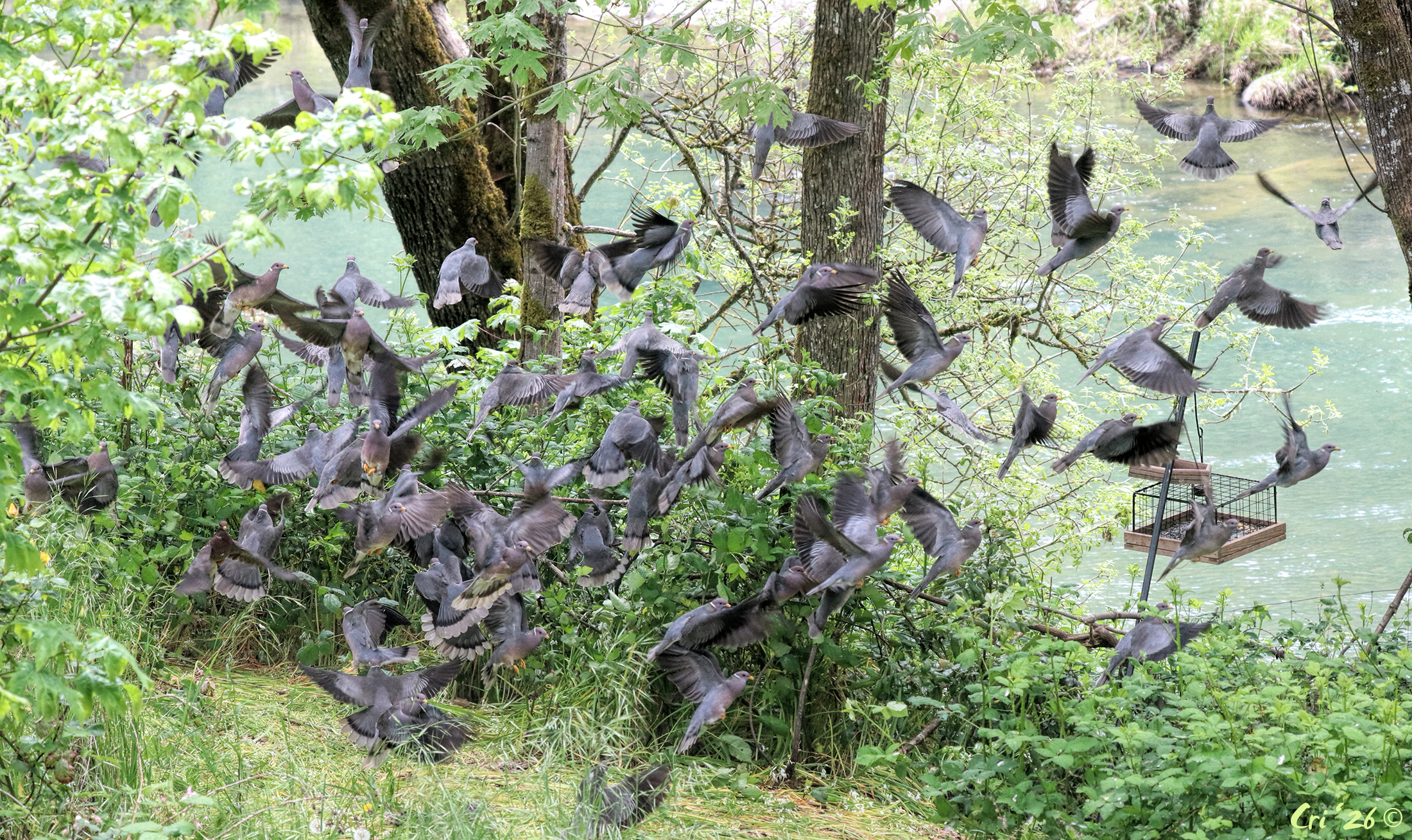
Upshot, yes the Band-tailed ate the corn. In fact I had a one-day massive influx of migrating Band-tailed which sent my yard population from 40 birds to just over 100 birds for 12 hours (see photos and video) and those pigeons ate a lot of corn.
Also, yes, that $10 for 40 was correct. The “wild bird” corn and the “livestock corn” are…the EXACT SAME CORN. It’s all in the packaging, and I suppose some marketing person somewhere knowing folks who feed wild birds will spend more money *sigh*. It pays to research.
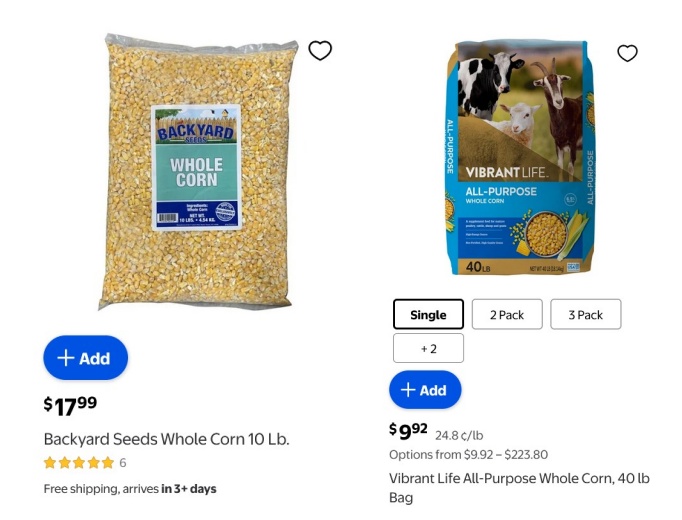
So from here out, $10 for 40 corn is what the Bandies will get, and the more expensive (but still super cheap) seed will go into the “No Bandies Allowed” feeders.
The $10 for 40 won’t help you much if you’re only feeding songbirds. But whole kernel and cracked corn are great for many types of birds. It’s almost always included in seed mixes and in high energy suet, so songbirds will eat the smaller cracked corn bits.
If you have quail, doves, pigeons or even squirrels and deer you like to feed, get you some of that $10 for 40 “livestock” whole kernel corn and…you’re welcome!