Crawlies with Cri – Short-nosed Scorpionfly

By Christy Solo – ONPA 1st Place Award Winner for Best Local Column

As long-time readers know, once in a while we revisit a past crawly if we feel we didn’t give that crawly enough attention the first time around.

This is one of those! I recently found this week’s crawly – the first I’d seen in 10 years – and realized “I don’t know how to find this critter. I don’t know anything about their life history. I’ve found a (literal) few just by stumbling upon them.

So who is this crawly in such dire need of a redux? We’re glad you asked!

This week we’ll (re)meet—wait—what IS that thing?

First, don’t panic! As crazy as this week’s crawly looks, he’s totally harmless! Meet the Short-nosed Scorpionfly (Genus Brachypanorpa). Despite his common name, the scorpionfly is neither a scorpion nor a fly. They are in the Order Mecoptera a very small group of flying insects which includes scorpionflies and their cousins hangingflies.

Scorpionflies got their common name because the males’ tails resemble a scorpion’s. Unlike scorpions, however, scorpionflies don’t sting. As for “short-nosed” most scorpionfly species have long faces (which look like noses), but our special species does not.

photo of a common scorpionfly male. he is on the trunk of a tree. you can see his scorpion like tail and very long face.
Male Common Scorpionfly (Family Panorpidae). Looking at his long “nose” you can see why our special species are called “short-nosed”! Photo by Clinton & Charles on Flicker

Special? Boy are they! There are 55+ species of Common Scorpionflies (Family Panorpidae) in North America.

However, there are only five species of short-nosed scorpionflies and they are only found in the United States! Two species live in the east (VA, NC, TN) and three in the west (MT, CA and OR). Basically, these nubby-nosed critters are as rare as hen’s teeth in the big world of insects. Lucky for us we have them here in the Upper Rogue!

How rare are they really? There are only 261 recorded sightings of short-nosed scorpionflies on iNaturalist. The good news is 98 of those are in Oregon!

With so few species of short-nosed, and those split populations, it’s thought that the Short-nosed is a relict surviving from ancestors which were spread nationwide in the early Tertiary (66 million to 2.58 million years ago)!

To put that in perspective, that’s like a pocket population of Wooly Mammoth wandering around today – only even older. Well, small Mammoths because at about one-quarter of an inch in length, today’s short-nosed are about half the size of their fossilized ancestors found in the Pacific Northwest.

So, how can you find a short-nosed scorpionfly?

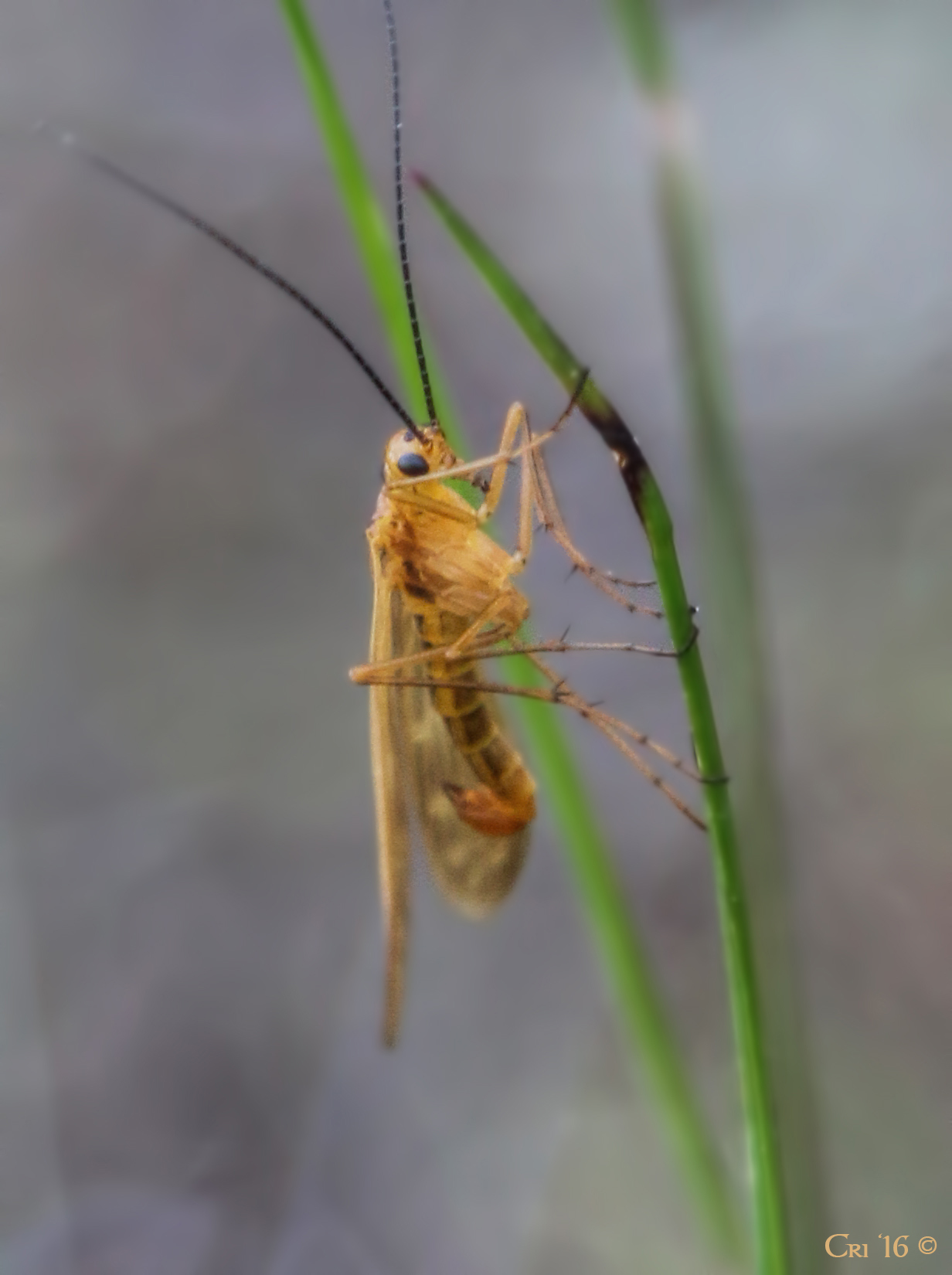
Sightings here are along the west side of the Cascades and along the coast. All the ones I’ve found were on Abbott Creek Rd. in the Rogue River National Forest. However I found them in three different places and on different perches including on plants and (this year’s) a dead tree.

two up collage of a short-nosed scorpionfly. the top photo he is in profile facing left and you can see his scorpion like tail. bottom photo is looking down on him and he resembles a stonefly.
Male Short-faced Scorpionfly (Genus Brachypanorpa). You can see how he got his common name in the top photo. In the bottom photo you can see that when you look down on them they look a lot like golden stoneflies. Photos by Christy Solo

Let’s dig into some fun facts about their life history. Not only do scorpionflies not sting, but they can’t bite us either. They have teeny mouths and no sharp, bitey mouthparts. So what do they eat? They dine on dead arthropods (no sting, no kill, so they get leftovers) this includes leavings harvested from spider webs. They also nibble on leaves, mosses, petals and pollen and sip nectar. They won’t turn down human sweat either.

Fun fact: Female short-nosed scorpionflies look quite different from the males. Not only do they lack the scorpion-like tail, but they are also wingless. To woo the ladies, males make the most of their “fancy” features, vibrating their wings and raising their tails.

Normally this is not enough to impress the ladies, however. The male scorpionfly’s big romantic move is to bring a nuptial gift to the female. Usually this nifty gift is a nice deceased bug. Romance is not dead!

Since the world is filled with dead bugs, the short-nosed scorpionflies’ meal choices don’t offer us much in the way of “how do I find one?” However, what short-nosed do need is moisture. Especially damp soil, so riparian areas, bogs, marshes, etc.

After accepting their buggy nuptial gifts, females lay their eggs in damp soil, and the eggs won’t hatch if the soil is too dry, they’ll sit in a suspended state until there is sufficient moisture. Scorpionfly larvae resemble teeny caterpillars and they eat plant matter.

Looking at sightings in our area, you can look for scorpionflies to be on the wing from early June through early July.

They don’t look like much at a glance, so arguably the best way to spot them is to see them take flight. With their color and size, they look similar to our little golden stoneflies until you see that scorpion tail! When there are a lot of them around, they are quite noticeable as you drive or hike through the woods.