
With almost officially here, hitting the water is a sure way to find relief. Whether in a pool, pond, lake, creek or river drowning is always a sad possibility as we in our area know too well.
Now is the time to learn the real signs of drowning, it’s not what you see on television or in the movies. Knowing what to look for can save a life.
Drowning is not the violent, splashing, call for help that most people expect. If you spend time on or near the water, as we all do here, then you should make sure that you and your family know what to look for whenever people enter the water.
The waving, splashing, and yelling that dramatic conditioning (television) prepares us to look for, is rarely seen in real life.
The Instinctive Drowning Response, named by Francesco A. Pia, Ph.D., is what people do to avoid actual or perceived suffocation in the water.
It does not look like most people expect. There is very little splashing, no waving, and no yelling or calls for help of any kind.

To get an idea of just how quiet and undramatic drowning can be, consider this: It is the number two cause of accidental death in children, age 15 and under 50% of children who drown will do so within 25 yards of a parent or other adult. In ten percent of those drownings, the adult will watch them do it, having no idea it is happening.
Drowning does not look like drowning.
In the Coast Guard’s On Scene Magazine, Dr. Pia described Instinctive Drowning Response:
- Except in rare circumstances, drowning people are physiologically unable to call out for help. The respiratory system was designed for breathing. Speech is a secondary or overlaid function. Breathing must be fulfilled, before speech occurs.
- Drowning people’s mouths alternately sink below and reappear above the surface of the water. The mouths of drowning people are not above the surface of the water long enough for them to exhale, inhale, and call out for help. When the drowning people’s mouths are above the surface, they exhale and inhale quickly as their mouths start to sink below the surface of the water.
- Drowning people cannot wave for help. Nature instinctively forces them to extend their arms laterally and press down on the water’s surface. Pressing down on the surface of the water permits drowning people to leverage their bodies so they can lift their mouths out of the water to breathe.
- Throughout the Instinctive Drowning Response, drowning people cannot voluntarily control their arm movements. Physiologically, drowning people who are struggling on the surface of the water cannot stop drowning and perform voluntary movements such as waving for help, moving toward a rescuer or reaching out for a piece of rescue equipment.
- From beginning to end of the Instinctive Drowning Response people’s bodies remain upright in the water, with no evidence of a supporting kick. Unless rescued by a trained lifeguard, these drowning people can only struggle on the surface of the water from 20 to 60 seconds before submersion occurs.
This doesn’t mean that a person that is yelling for help and thrashing isn’t in real trouble – they are experiencing aquatic distress.
Aquatic distress doesn’t last long, and is not always present before Instinctive Drowning Response, but unlike true drowning, these victims can still assist in their own rescue. They can grab lifelines, throw rings, etc.
Look for these other signs of drowning when persons are in the water:
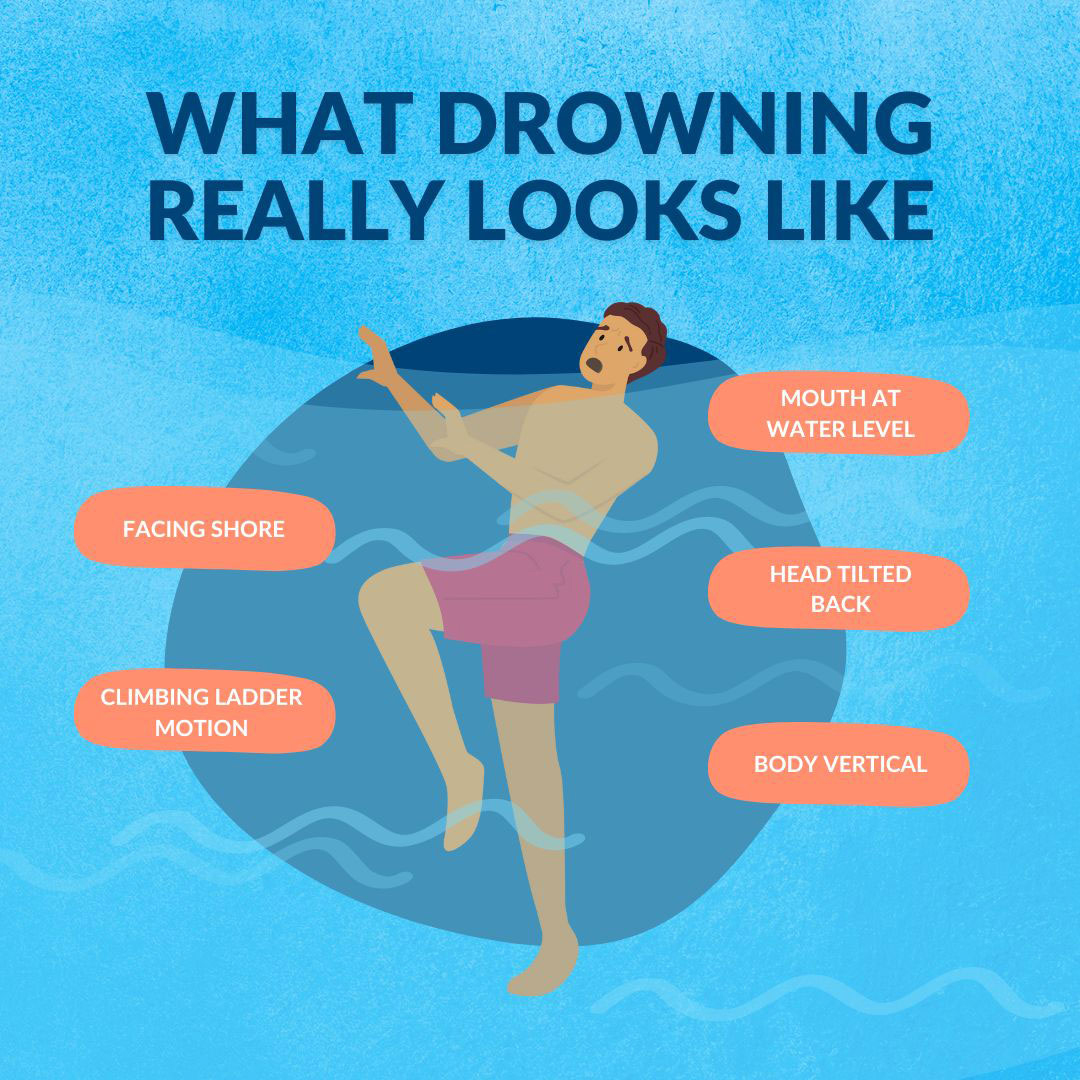
- Head low in the water, mouth at water level
- Head tilted back with mouth open
- Eyes glassy and empty, unable to focus
- Eyes closed
- Hair over forehead or eyes
- Not using legs – Vertical
- Hyperventilating or gasping
- Trying to swim in a particular direction but not making headway
- Trying to roll over on the back
- Appear to be climbing an invisible ladder.
Sometimes the most common indication that someone is drowning is that they don’t look like they’re drowning.
One way to be sure? Ask them, “Are you alright?” If they can answer at all – they probably are. If they return a blank stare, you may have less than 30 seconds to get to them.
When children are playing in the water, they make noise. When they get quiet, get to them and find out why.