All Things Oregon – Oregon’s iconic coastal birds Pt. I

by Christy Solo – Editor

As we head in to the “Dang! It’s hot!” summer months you may want to take a break from the heat and head over to the coast for a day or two. While there is no shortage of fun things to do along the Oregon Coast (or do nothing but chill), we’re going to give you just one activity over the next two weeks of All Things: Look for “Wait, what? We have those birds in Oregon?” birds.

Our very own mutual backyard is chock full ‘o birds and birding hot spots. We don’t even have to leave our back porches for avian goodness. However some of our Oregon birds found only along the coast are worth the effort, especially if you’re going west to beat the heat anyway.

Because there are hundreds of hot spots along the coast, and numerous coastal species, we’re going to control ourselves and focus on just two hot spots and a few species. You’re welcome.

Caveat: For the species we’ve picked a mix of “probably will see” and “a rare sight, but you sure won’t see it anywhere else in Oregon!” because what’s life without Big Goals?

Even if you don’t see any of our featured birds – you will see birds – lots of birds. Also the Pacific Ocean and beaches and cool rocks and tide pools. You simply can’t lose when you visit either hot spot.

Fun fact: Each of our coastal hot spots is basically equidistant from our area – as the crow flies. However, due to our utter lack of “as the crow flies” highways in Oregon, the drive times are vastly different.

So, we’ll start with the longer drive time, since we have to start somewhere.

Our first hot spot is Harris Beach State Park which is just north of Brookings, Ore. Pack the camping gear for this outing, you’ll want to set up your tent at this gorgeous park. Since this week is all about the birds, we’ll just give you the link to the park and you can explore the park online.

Drive time to the park is approximately 4 hrs. 5 min. if you dip down into Cali then go back up the coast. This may not be the best choice in winter, but it’s perfect for a summer drive and shaves off 15 min. from the “up, over and down” route that takes you north, then west, then south.

Fun fact: You will see a lot of birds at Harris Beach. There are recorded sightings of 207 different species of bird there. So far for 2026 there are 81 recorded species.

For the sake of brevity, we’ll look at three super cool birds you might see at Harris Beach: Black Oystercatcher, Pelagic Cormorant and Tufted Puffin. We’ll meet them in the order of “Odds are good you will see one” to “Well…there IS a chance!”

three up collage of a black oystercatcher, a pelagic cormorant and a tufted puffin in non-breeding plumage.
R: Black Oystercatcher with a snack, a Tufted Puffin in non-breeding plumage. Photos via ODFW
L: A Pelagic Cormorant refracting the rainbow. Photo by Kevin Cole on Flicker

First up is the Black Oystercatcher (Haematopus bachmani). They can be spotted at Harris Beach any month of the year and their unique shape and dramatic coloring make them easy to see. Bonus! Oystercatchers are shore birds, so you won’t need binoculars to see them waaay out on the waves.

When it comes to the black oystercatcher, the product matches the name on the packaging. They are black, they catch oysters. Look for them when tides are falling because they’ll be there waiting to catch mollusks and other aquatic invertebrates for supper. 

Fun fact: The oystercatchers’ Genus name Haematopus means “blood-footed” in Greek.

You may hear the black oystercatcher’s high, rising whistle call before you catch sight of them. Couples stay paired year-long and will often fly in pairs over the water whistling their tune before landing to look for food.

They prefer flat areas, so won’t usually be hanging out on cliffsides.

Next up is the Pelagic Cormorant (Urile pelagicus). You may have seen our local Double-crested Cormorants (Nannopterum auritum) at the Holy Water behind the dam at Lost Creek Lake or even along the river; pelagic are their darker, rainbow-y-er goth cousins.

Pelagic are smaller and slimmer than double-crested, but they have the same stunning turquoise eyes. Their feathers, however, are black and refract a rainbow similar to the feathers of European starlings and Brewer’s blackbirds.

Fun fact: “Pelagic” means “of the open ocean” and…it’s totally wrong. In fact pelagic are rarely seen very far from the shore. Great news if you hope to see one at Harris Beach. Sightings can be feast or famine, but on June 17, 2026 one eBirder saw 50 of them! So prepare to be visually dazzled.

Pelagics are expert anglers. They can hold their breath for two minutes and dive as deep as 138 feet to catch fish. Unlike double-crested who fish in waters with flat or sandy bottoms, pelagic prefer rocky waters.

Final fun fact: Pelagic Cormorants often nest on cliffs quite close to coastal roads and paths, allowing close views and they use their own guano (poop) to shore up their nests and adhere them to the cliff’s surface. Waste not, want not!

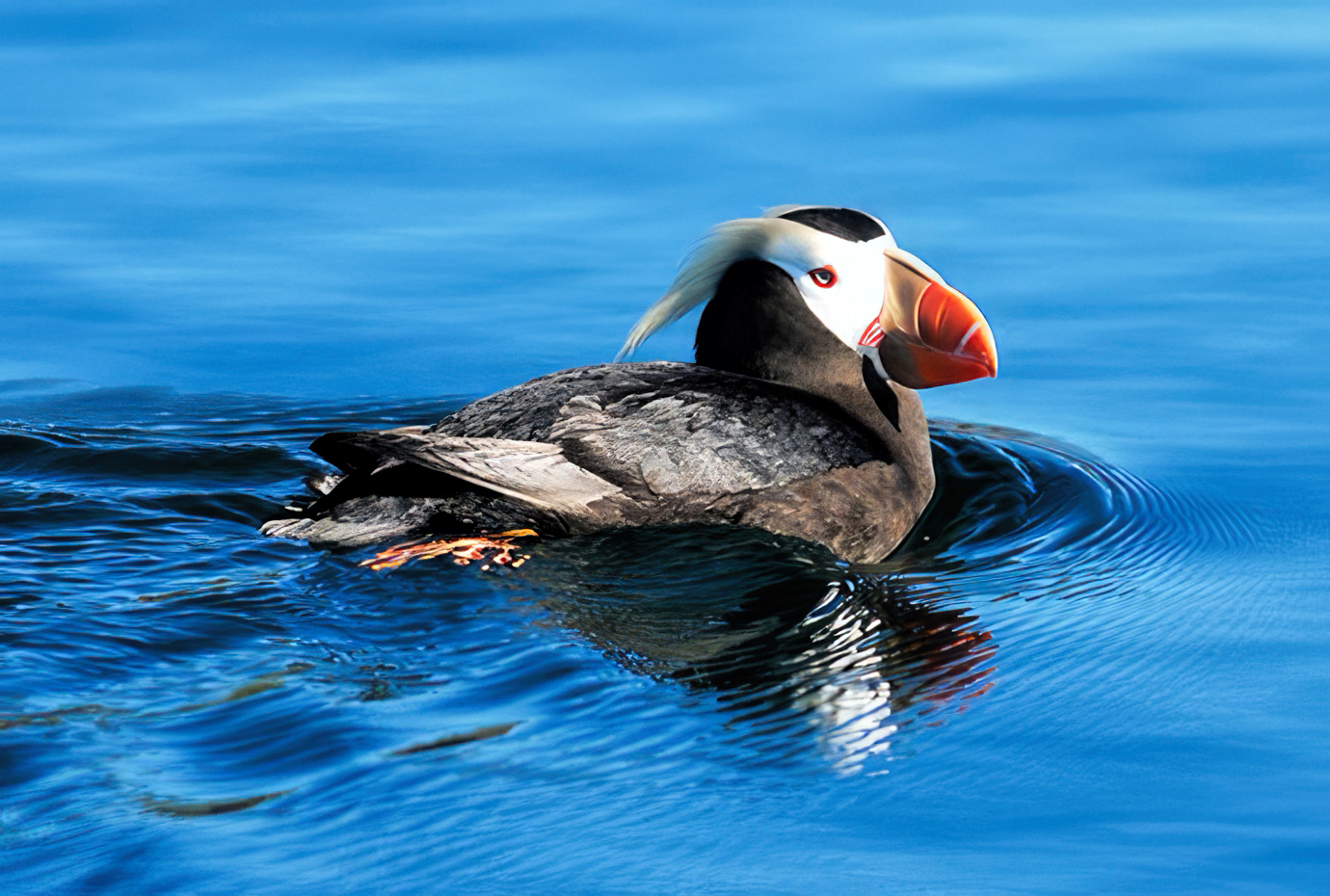
Our final feathered friend for Harris Beach and this week’s All Things Costal Birds Part I is the absolutely iconic Tufted Puffin. Not only do they have a fun name to say (go ahead, say it out loud three times, we’ll wait) but they are a year-round Oregon resident and just might be our state bird if that title hadn’t gone to the Western Meadowlark.

We will say your best chance of seeing a tufted is to travel way up the coast to Canon Beach (5hrs. 27min.) Canon Beach is known for puffins and they have appeared on nearly every eBird checklist for that hot spot all June long.

However, you just might see one at Harris Beach, especially in July or August.

Fun fact: Tufted puffins are the Chinook Salmon of the bird world. They spend the non-breeding season entirely out in the open sea. Young birds may spend their entire youth at sea, returning to land only when they are three years old. Then they breed on the same nesting cliff where they hatched. Luckily for us and puffins, they don’t then die from the rough journey like Chinook do.

And where on those home cliffs do young puffins nest? They dig deep burrows into the edges and slopes of cliffs. How deep? A puffin burrow can be up to five feet deep.

But wait, there’s more! If you think they dig deep, wait until we tell you how deep they can dive. Tufted puffins will dive up to 360ft. below the water – using their wings to “fly” as they go. The object of their deep water quest is small fish. Adults will eat while still submerged, then catch up to 20 more minnow-sized fish to take back to shore and feed their young.

Come back next week for Part II of our cool, coastal Oregon birds.