Crawlies with Cri – Mink

By Christy Solo – ONPA 1st Place Award Winner for Best Local Column

Longtime Crawlies readers know that 99.99% I write about local crawlies who I have seen – and photographed. Occasionally I’ll use a second photograph from a friend or iNaturalist – but always include at least one of my own.

I’m breaking my own rule because while I have seen this week’s crawly, I will most likely never see another one and I was not able to get a photo – not even a poor quality iPhone pic.

This week’s crawly is mischievous, mysterious and whoo boy – they are quick!

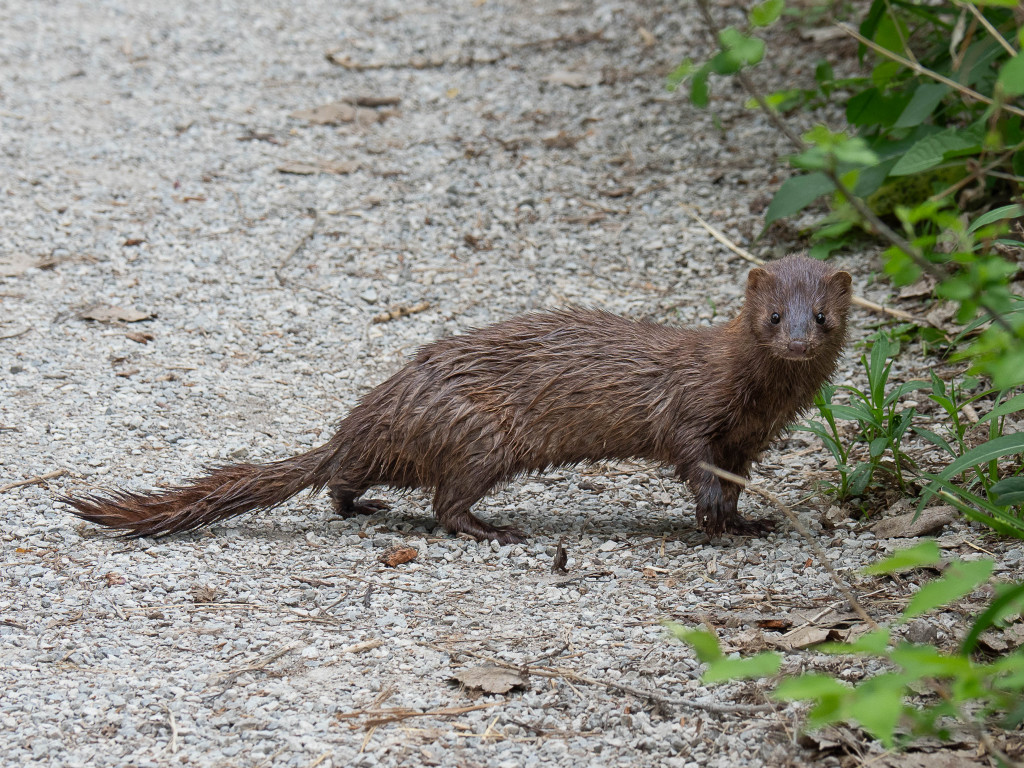
Meet the American Mink (Neogale vison) who we generally just call “mink.”

Wait, what? We have mink in Oregon?

Yes. Yes we do.

The only reason I knew this is that in my mom’s 70+ years of traipsing all over Jackson County and the surrounding area, mostly in riparian areas, she saw ONE mink ONE time.

She talked about that ONE mink a lot. A. Lot. I figured it must have been a pretty spectacular critter.

They are.

I was driving on the highway (in the riparian zone) last week and I braked for a Western Gray Squirrel crossing my lane—

Suddenly my brain screamed, “That is NOT a squirrel!” I then slammed on the brakes and swerved (mostly *cough*) onto the narrow shoulder literally screaming out loud “Holy *(&%$!” as I watched the very-much-not-a-squirrel-but-a-mink dash into the brush next to my car, then dart around in and out of a small blackberry bramble for a few seconds before disappearing out of sight. There was zero chance for a photo (even if the shoulder had been wide enough to safely and fully pull over).

Wait, what? Mink are squirrel sized?

Yes. Yes they are. Well, give or take.

So let’s meet the mink.

Despite my family’s sore lack of mink sightings, you do have a more than zero chance of seeing one. There are 434 recorded sightings of minks in Oregon on iNaturalist (and you must have a photo, so no doubt many more brief encounters like my mom’s and mine).

Mink can be found throughout the state, but most of the sightings are along the west side of the cascades and along the coast.

Of course if you want to see a mink, you first have to know we have minks in Oregon. So we have that checked off our list. Second you need to know how tiny they are. I freely admit I thought they were much larger (and now really cringe at the thought of how many of them it would take to make a full-length coat).

Size-wize mink fall in between gray squirrels (our largest tree squirrel) and martens. That is to say, males average 15 inches in length and females 13 (Western Gray Squirrels average 12 inches). They are very tiny apex predators.

Because we have several mustelids in Oregon (minks, fishers, martins, weasels, ermine) you might think it would be difficult to distinguish a mink in the mix. Luckily minks are that rich, well, “mink brown” all over (sometimes with a small white chin patch) whereas their other mustelid cousins have more shades of fur and/or very distinguishing markings. Minks move in a tell-tale way as well; their movements are rapid and erratic as if they are always ready to either flee or pounce, because basically they are always ready to do one of those things.

four up collage of minks in the wild.
The many faces of minks – all adorable (if you aren’t a crayfish or small mammal). Photos via The National Parks Service and Alaska and Nebraska Park services.

Minks will always be near water as they are a semi-aquatic species. To help them navigate our chilly waters they are equipped with oily guard hairs to help repel water and semi-webbed toes which make them excellent swimmers.

It’s no surprise there is a lot of “seafood” in their diet. However we weren’t exaggerating with the “tiny apex predator” comment. Mink will eat virtually anything they can catch and kill, including fish, birds, bird eggs, insects, crabs, clams and small mammals.

On land, their sleek and slender form allows them to access the dens or burrows of their mammalian prey.

Though small and cute, mink hold a significant spot as a top predator in their ecosystem. They exert a top-down influence on their ecosystem, shaping the distribution and behavior of other species within their food web.

By taking out both aquatic and land “pest” species (invasive crawfish, rats, mice, etc.) minks help prevent overpopulation and potential ecosystem imbalances. These cute little marauders are definitely more beneficial off the rack and in the woods.

Final Fun fact: Within a single litter of baby minks (4-10 kits) there can be kits fathered by two (or more) different males, and even “older and younger” kits. Technically kits are all the same age, but because minks’ fertilized eggs don’t attach to the uterus to develop right away, one litter can have kits from two separate periods of ovulation.

The delay in the eggs attaching allows pregnant minks to keep track of environmental conditions and select an ideal time and place to have their kits.

Kits are born any time between April and June and mum mink does all the caregiving. Kit minks can hunt when they are about eight weeks old, but they will stay with their mum until fall when they are fully grown enough to seek out their own territories.

Oh and baby minks are even cuter than adults.