by Christy Solo – Editor
Bird migration season is heating up and if you aren’t already seeing more birds in your yard – or at least different birds – you will be soon.
This time of year especially I get a lot of questions in person and via social media about “what do you feed your birds” so—
In this week’s All Things we’re going to delve into “How to feed Oregon’s migratory bird hoards without spending your life’s savings.”
First things first. Learn your birds (you may already know them!) Not down to species per se, but:
- Do you have more birds in winter or summer
- Do birds nest in your yard
- Do you have about an equal number in both seasons, but different species
- Do you get “layover” birds such as White-crowned Sparrows who eat you out of seed and home – but only for a couple of weeks in spring and fall
Knowing this will help you decide how much food to buy, whether or not you want to spend a bit extra for the heaviest migration weeks and what types of feeders to buy.
Important: You do not have to have Rockefeller amounts of money to feed backyard birds. You absolutely can spend Rockefeller amounts of money on very high-end food if you can afford it and are so inclined, but it is not necessary. Not. At. All.

Pro tip: You do want to sort out which seeds your yard birds will actually eat, or you’ll just have a yard full of uneaten seed.
Cornell Lab’s Project Feeder Watch: Common Feeder Birds webpage is a great jumping off point. You can click on the pic of a bird you have in your yard, and a window will open showing you their preferred seeds and feeder types.
Pre Pro Tip Pro Tip: No food/feeder/bird tip will be 100% – birds are individuals and individual flocks of the same species will even have different preferences than other flocks of the same species.
For example: The House Finch list via Cornell shows they like safflower seeds. They…do not. When I put out Grange Co-op’s Dove and Quail mix – which is millet and safflower, I end up with a yard full of safflower seeds which no birds – except doves, who will eat anything – will eat.
The upshot is: the Project Feeder Watch web page is very useful! But don’t be discouraged if the birds in your yard aren’t wild about every choice offered. You’ll need to experiment some to find the seeds that flip their birdy switches!
There is one “can’t lose” type of seed. Black oil sunflower seed (also sunflower chips, but those are exponentially more expensive – we’ll get to pricing in a bit).
Seriously. Go click around the Project Feeder Watch page when you’re done reading and you’ll see black oil comes up for nearly every bird. The big bonus? Black oil is the second cheapest type of seed you can buy (though where you buy it matters, a lot).
Another thing you’ll notice looking at the Project Feeder Watch birdy faves pop up pics is that there are really just a few basic wild bird seed types.
Why then are the wild bird seed aisles at all our local stores so overwhelming? There are dozens of options from simple “Classic Blends” to fancier fare like “Deck and Porch” (what does that even mean?) or “No waste”, “Nut and Berry”, “Squirrel and Critter” (seriously, it’s a type) and even more mixes to mystify you such as “Cardinal Blend” or “All Birds” or “Song Birds” or, or, or.
Really? It’s all about marketing and packaging. For example: A bag of only cracked corn is (best price) $0.50 per lb. and a bag of only black oil sunflower seeds, also (about) $0.50 per lb. BUT a bag of mixed cracked corn and black oil sunflower seeds – suddenly it’s $1.00 per lb. Yup.
So if you take away nothing else from this article remember this: You can easily feed your array of yard birds with the cheapest possible seeds and seed mixes.
Just get black oil sunflower seeds, generic “bird seed” AKA “classic mix” AKA “economy blend” and a suet block or and that’s all you need. If you’re feeling fancy, add in an inexpensive finch blend which has smaller sized seeds and chips, however finch are perfectly capable of chowing down on full sized fare.
Suet: Many hopper feeders come with attached suet cages, easy peasy! You can also buy hanging suet cages. While not on our list below, the absolute best suet prices are at Walmart when you buy the value pack of eight suet blocks.
We’ve broken down the prices for the basic seeds you’ll need below (and threw in hulled sunflower seeds for anyone who wants to really spoil their birds and/or doesn’t want to deal with sunflower shells).
We’ve calculated the price per lb. – as well as specifying the least expensive brand at each location – at our three local “best prices on seed” stores. All three stores also have a huge variety of seeds and brands as well as bird feeders for sale.

Pennington Feeder Frenzy Brand at Walmart
Black Oil: 20 lb. $16 40 lb. $21 (40 lb. $0.53 per lb.)
Classic Mix: 20 lb. $14, 40 lb. $18 (40 lb. $0.45 per lb.)
Sunflower chips: 15 lb. $30 ($2 per lb.)
Finch Blend: 10 lb. $14 ($1.40 per lb.)
Vibrant Life Brand at Walmart:
Economy Mix 20 lb. $11, 40 lb. $19 (40 lb. $0.48 per lb.)
Nature’s Own Brand at Coastal – these are sale prices as of April 22 (about $2 off per bag)
Black Oil: 20 lb. $18, 40 lb. $23 (40 $0.58 per lb.)
Premium Blend Mix: 20 lb. $13, 40 lb. $19 (40 $0.48 per lb.)
Country Blend Mix: 20 lb. $10, 40 lb. $17 ($0.42 per lb.) (more corn than Premium)
Sunflower Hearts: 15 lb. $25 ($1.67 per lb.)
Finch Blend: 15 lb. $18 ($1.20 per lb.)
Grange Co-op – Rogue Brand & lowest non-house brands
Black Oil: 20 lb. $18, 40 lb. $33 (40 $0.83 per lb.)
Deluxe Mix: 20 lb. $26, 40 lb. $45 (40 $1.13 per lb.) (best quality mix)
Sunflower Chips: 20 lb. $40 ($2 per lb.)
Wild Finch: 5 lb. $15, 20 lb. $55 (20 $2.75 per lb.) (best quality finch)
Now, we’d be remiss if we didn’t also mention a few sweet treats you may want to put out for feathered friends who favor fruit. Many songbirds favor fruit during breeding season (that being the season it’s available).
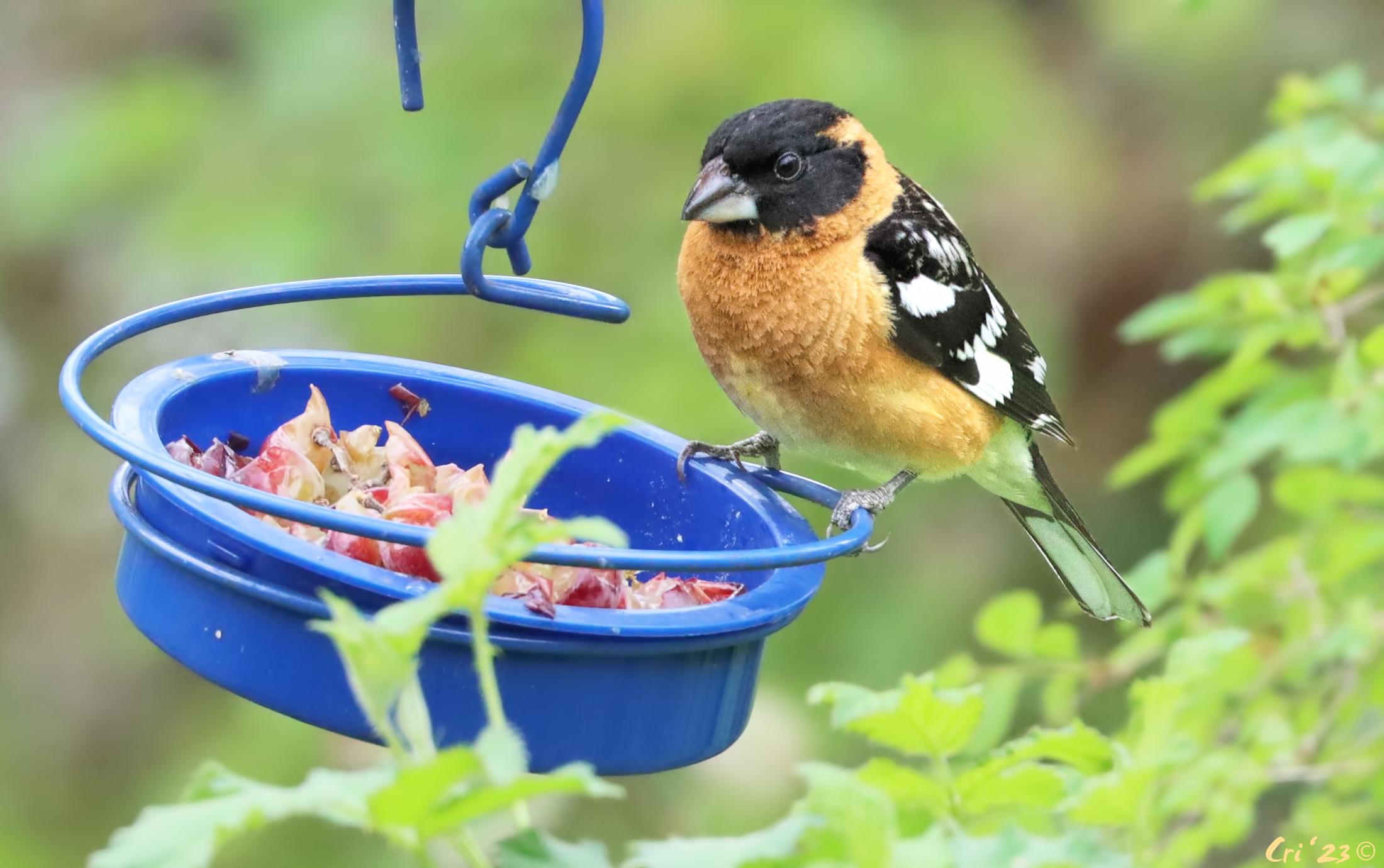
Our fruit loving area birds include (but are not limited to): Bullock’s Orioles, American Robins, Black-headed Grosbeaks, Western Tanagers, Acorn Woodpeckers and Cedar Waxwings.
Feeding fruit is easy! Cut oranges in half and stick them on the stub of a broken tree branch, or you can get fancy and buy a special Fruit Feeder (see photos).

While they are more expensive than oranges, our fruity birds also love grapes. You can just set grapes out in a hanging bird feeder dish, or even a glass pie plate. Fruity birds – especially orioles and grosbeaks – love grape jelly. Walmart brand will do and you can either set some out in an inexpensive glass dish or two or buy – you guessed it – they also make special jelly feeders.
As for seed feeders; so many choices! Whether you want to go for inexpensive or aesthetic, you have a million options. Check the Backyard Feeder Project site for some ideas.
You can’t go wrong with a platform feeder. Birds of all sizes can access them and many birds prefer them.
Basic hopper feeders are a great option too, easy to fill and clean.
Caged feeders are a bit pricier, but absolutely worth it if you have Collared Doves or Band-tailed Pigeons who will hoover up every bit of seed they can access. They can NOT access caged feeders, but songbirds as large as Black-headed Grosbeaks can.
Corvids such as our Steller’s and Scrub Jays are wily enough to access caged platform feeders, but they cannot consume the enormous volume of seed that doves/pigeons can, so don’t worry.
Pro tip: Whichever feeder type you get, you do need to clean and sanitize feeders every few weeks. Buying glass dome feeder covers cuts your cleaning time by a lot. Keeping seed dry also helps prevent it from being wasted (even hungry birds won’t eat mushy seed) and from growing mold.
You don’t need fancy feeders, or feeders at all, however. You can just scatter seed on the ground or a porch railing or on a piece of plywood. You do want to keep seed out of standing water such as ponds or bird baths, even “no mess” seed blends will mess up water quickly.
Final pro tip: Don’t want to haul a 40 lb. seed bag into your shopping cart, then into your trunk, then into your house (porch, garage, whatever)? Walmart will ship all of their seed brands and shipping is free if you spend $40 or more (you can also look into free home delivery in the Eagle Point area or order online and pick up at Walmart).
Grange Co-op will also spare you the “shelf to cart, cart to car” loading and you can have them load your large bags into your car in the warehouse and it’s likely Coastal also has that option.