By Christy Solo – ONPA 1st Place Award Winner for Best Local Column
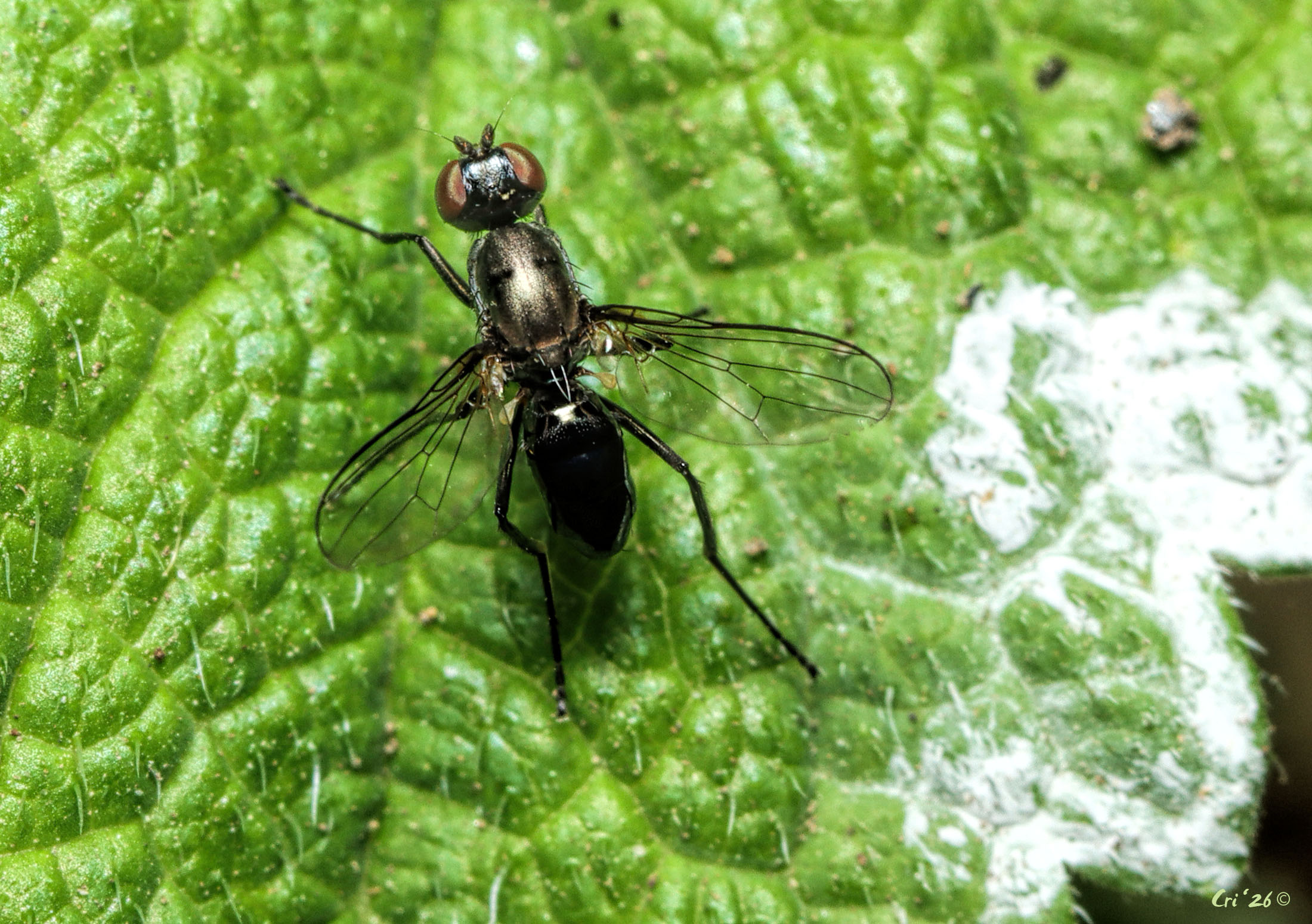
This week’s crawly put the “B” in “Beneficial”; they are also excellent dancers. Meet the black scavenger fly (Family Sepsidae) AKA the ensign fly.
What’s in a name? There’s a lot to unpack here.
First a fun fact: ensign flies aren’t the only flies known as “black scavenger flies.” There are also “minute black scavenger flies” who are in the Family Scatopsidae. With “scat” right there in the minute’s name, you can guess what their larvae eat. Your guess would be correct.
When it comes to the “ensign” moniker our pictured scavenger fly has a lock on the common name, so we’ll call them “ensigns” for the duration.
Why “ensign?” We did mention they are excellent dancers, right? When not doing other fly things (we’ll get to those) ensign flies have a habit of hanging out on foliage dancing about and waiving their wings in the air like they just don’t care.
Fun fact: “Ensign” isn’t just a military rank, it also means, “a flag that is flown (as by a ship) as the symbol of nationality and that may also be flown with a distinctive badge added to its design” Merriam Webster Dictionary.
When it comes to ensign flies in the Genus Sepsis, the “distinctive badge” on their waving wings is a single black dot on the top area of the wing. So the “ensign” common name makes a lot of sense.
Our pictured ensign is not in the “dot on the wing” Genus, but they were waiving their little wings, they don’t need no stinkin’ badge.

The “scavenger fly” version of the ensigns’ common name is also accurate; they are part of nature’s cleanup crew. This is also covered in their Family name, Sepsidae. This comes from the Greek sepsis which means purification or decay.
No doubt you’ve pieced together by now the fact that ensign fly larvae eat decaying organic matter. That they do, and their work in that area is very beneficial.
Although ensigns don’t have “scat” right there in their name, both adult and young ensigns do favor mammal scat as a meal.
If you spot an adult ensign fly, there’s a good chance there’s some scat nearby which female ensigns will lay their eggs on.
However, ensign fly larvae will also eat other types of decaying organic matter such as fungi, decomposing plants and even carrion. Not only do they break down “rotting stuff” into “stuff which is beneficial to our soils” but they are also sometimes used in forensic entomology to help determine time of death.
But wait, there’s more!
Adult ensigns get their minerals from scat and other decaying organic matter, but they get their sugar from flower nectar, so they are also pollinators. We weren’t kidding about that “B” in “Beneficial!”
If you’d like to see an ensign fly in real life and thank them for all the icky work they do to help keep our area a cleaner place, you’ll have to look sharp. At under one-quarter of an inch (4mm) they can be hard to see, but their wing-waving dance does draw attention.
There are 34 species of ensigns in North America, and they all waive their wings and look nearly identical to our pictured fly – which you may have noticed also looks a lot like an ant. While there have been many studies done on ensign flies, those have focused on the ensigns’ benefits not on “why are they ant mimics?” so that’s a secret still known only to ensigns.
Oh, and if you do spot an ensign out in the wild, feel free to wave back, they’ll probably appreciate it.