by Dr. F. Alice LeDuc
Welcome to Ceanothus Part II – you can read Part I here
This week let us look at the white flowering Ceanothus Oregon Tea and Snowbush both late spring early summer blooming. Oregon Tea Tree is an erect deciduous shrub with alternate leaves. The stems are green when young, becoming red-purple at maturity. The leaves have a short petiole and a thin blade that is widely oval with a pointed tip, and tiny teeth. The flowers are borne on red stalks at the terminals of the stems, the clusters are less than five inches long, fragrant. The plants are found in dry open sites often at the edge of forests at low to mid elevations. These areas are referred to as chaparral vegetation. Like theafore mentioned plants this species also fixes nitrogen into the soil. The Snowbush is an erect to spreading shrub with brown stems found on both sides of the Cascades in our area. The leaves are evergreen, strongly fragrant and sticky, widely oval with a round tip, one to three inches long and finely toothed. The flowers are white in thick rounded clusters less that six inches long at stem tips. It can be found inland at mid to high elevations most commonly on disturbed sites along roads in logged and rocky soils.

This is another chaparral species. Deer browse in winter and the Indigenous people created a drink of boiled plant parts to induce sweats and for treating fevers, colds and influenza.
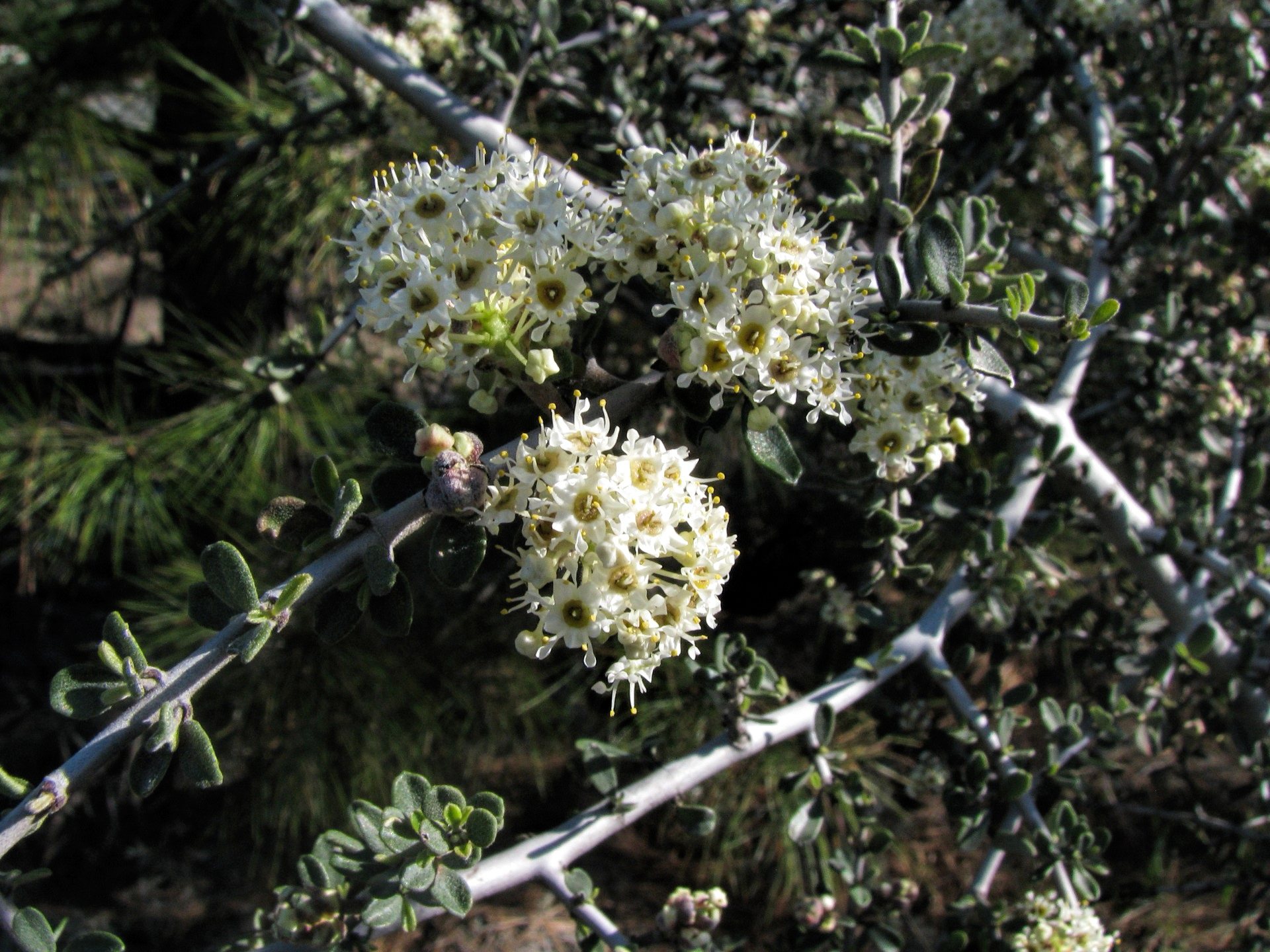
The other two species Buckbrush and Deerbrush are our last two species. They are chaparral plant s as well. Found in the western U.S from Oregon to northern Mexico. Deerbrush has a wider range that goes eastward into Arizona and New Mexico and north to Washington. Buckbrush is an evergreen shrub, rigidly upright to six feet. Stems freely branching and silvery green, often spine tipped. Leaves are less than one and a half inches long, oblong-round, thick gray-green on upper side of smooth leaves, lower side gray with fine hairs. Flowers in clusters of 20 – 60 individuals on branches, white, pale blue, or lavender on short stalks, fragrant.
They are found on hot dry sites, poor soils including serpentine at low to mid elevations. Of special interest, the species is host to six different species of butterflies and two species of moths.

The last species is Deerbrush a deciduous shrub to twelve feet, the stems are yellow to pale green. It is found on both sides of the Cascades in our area. The leaves are alternate, lance-shaped to widely oblong, one to three inches long. The surface is bright green on top and lighter below with few to no hairs. The inflorescences are six inches long with many stalked clusters of tiny white to pale blue flowers. The seed pods are sticky. Deerbush can be found in openings of mixed forests at low to mid elevations.
Deerbrush is an important species in forest regeneration as it too is a nitrogen fixing plant. In addition, the deer browse the foliage, porcupines and quail eat the stems, both are an important source of protein especially in fall and early spring when the quality of protein is highest.
Among the human uses the Indigenous people wove baskets using the branches. Because of its drought tolerance this species has also found its way into numerous landscapes. As our climate is changing and in many places getting hotter and drier native plants with ornamental value are becoming more and more important to home owners. A Brother-in-law living in the Sacramento area in California has replaced all his lawn areas with extremely attractive beds of drought tolerant native plants that are happily surviving and flourishing with no additional watering. This is known as xeriscaping. So, if this type of idea is in your present or future, please add Ceanothus species to your plant list.