By Dr. F. Alice LeDuc
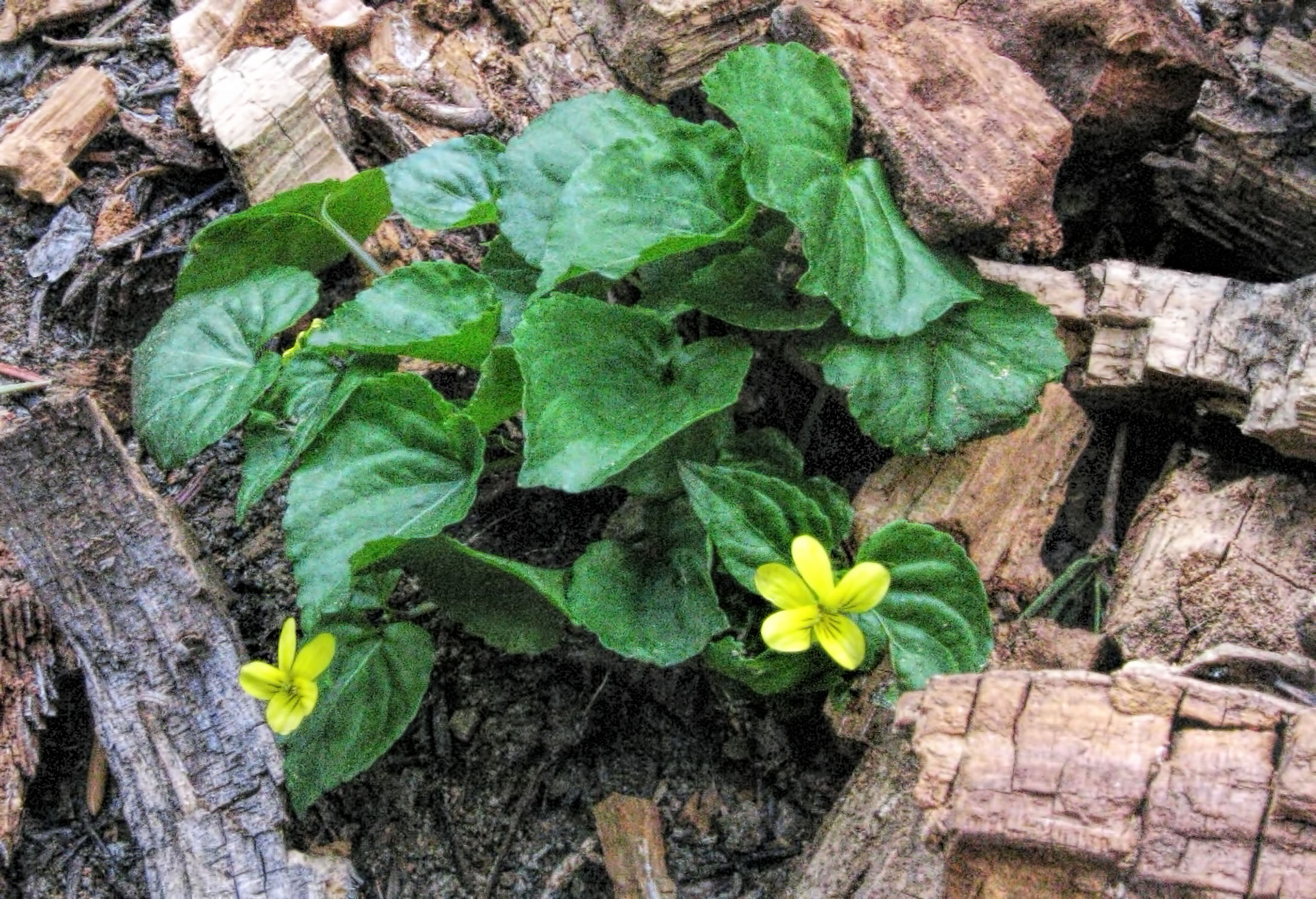
Violet – Viola species with yellow flowers
Violets bring many things to mind, in the language of flowers of Victorian times England, the violet meant shy and retiring demeanor, humble virtue. Often associated with romance, presented in a cluster of flowers or nosegay. Usually, we think of violet flowers as lavender or purple in color but other colors exist. Let’s consider some of the local violets.
There are about 30 species of violets in the Pacific Northwest. If you group the violets by flower color there re 3 species of white flowering violets of which 2 are found in our region. There are 8 species with lavender/blue flowers of which 6 are found in our region and 9 species with yellow flowers of which all 9 species can be found in our region. Today we are going to look at the yellow flowered species which are as follows: Viola douglasii – Douglas’ Violet; V. glabella – Smooth yellow Violet; V. hallii – Hall’s Violet; V. lobata – Pine Violet; V. orbiculata – Round-leaved Violet; V. praemorsa Prairie Violet; V. purpurea – Goosefoot Violet; V. sempervirens – Evergreen Violet; V. sheltonii– Shelton Violet.
The main problem with the yellow flowered violets is superficially 8 of them look very much alike until you focus in on a number of characteristics. We can set Hall’s Violet aside because the flowers are bicolored, the upper two petals purple and the lower three petals white with a yellow blotch in its throat and burgundy veins at the base of the petals. Moving on, let’s look at the leaves, three species have compound leaves Douglas’ violet has narrow oval leaflets; Shelton’s Violet leaves are horizonal just above the ground, the leaves are round and the three leaflets are lobed; In addition to having a different flower color the leaves of Hall’s Violet are compound with divisions that are quite narrow. Two species have heart shaped leaves, the Smooth yellow Violet leaves have a sharp tip and entire or small toothed margins and the Evergreen Violet leaves have purple spots on the underside. The remaining four leaves each are variously shaped. Prairie Violet and Goosefoot Violet leaves are very variable oval, oblong to lanceolate. Pine Violet leaves are unlobed to palmately three to eleven lobes. The round-leafed Violet tend to be orbiculate or roughly round. In addition, the flowers of this latter violet have no beards (clusters of hairs) on the two lateral petals. Shelton’s Violet flowers also have lateral petals that are beardless. All other seven species have beards on the lateral petals of the flowers. To compound the problem of identification all the species except Douglas’ Violet have maroon veins on the at least the lower petals. Douglas’, just to be different has brown veins. If these characteristics leave you confused just enjoy the little yellow flowered plants.

The habitat of all species is meadow areas in forests, some in wet areas or along streams or occasionally on gravelly slopes. Five species (Douglas’, Smooth-yellow, Hall’s, Pine and Evergreen) are found only on the west side of the Cascade Mts. The other four (Prairie, Goosefoot, Round-leafed and Shelton) are found on both sides of the Cascades.

So, as spring arrives start looking for these quiet, shy little plants. Perhaps consider adding some to your garden. I love when the violets come up in the grassy areas where their flowers can delight one so easily.