by Wayne Lee – Reporter/Photographer
The Eagle Point City Council met April 28 to have one discussion and consider two resolutions.
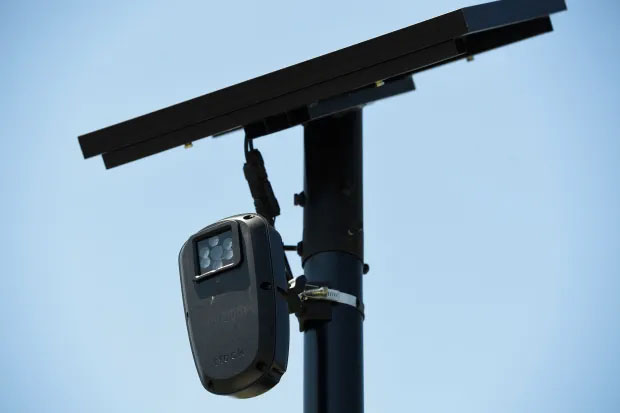
The discussion was regarding the five Flock cameras around town photographing car license plates. Earlier this year, a local resident asked that the cameras be removed because of issues of privacy and possible misuse of the information gathered.
Note: Eugene, Springfield and Lane County have suspended their Flock contracts. Bend has turned off their Flock cameras and Florence is having discussions on whether to turn theirs off or suspend their contract.
These concerns and others have been raised in cities throughout Oregon, and the state passed SB 1516. The 16-page law was part of an omnibus public safety bill that received bipartisan support and was passed March 31. The bill included an emergency clause which made the law effective immediately. Under the new law, Oregonians will be able, “to sue private companies that sell, misuse or otherwise improperly use data captured by license plate reading cameras.”
The law limits the retention of such data to just 30 days unless it is liked to a criminal inquiry or court proceedings, allowing law enforcement to retain it as they pursue their investigations. Authorities must now log the purpose of their searches, the specific crime/violation being targeted and the identity of which law enforcement agency they work for.
Although Oregon has sanctuary laws preventing state and local law enforcement from assisting federal immigration officials without a court order, civil rights advocates raised concerns the data collected by the cameras could be used to track immigrants and people seeking an abortion even in states that have laws protecting those individuals.
According to a report in the Portland Oregonian, University researchers and journalists have documented how the U.S. Border Patrol and Customs Enforcement accessed camera data in states such as Oregon and Washington. According to an Oct. 2025 report, the U.S. Border Patrol had access to the data bases of at least 10 different Washington police departments without explicit authorization. It was also reported in June of last year that local agencies outside of Oregon searched the networks of local law enforcement agencies hundreds of times on behalf of ICE according to the Oregonian Law Center.
The new law also requires any vendor that contracts with law enforcement agencies must provide monthly and quarterly audits which must also be made available to the public. The audits would include information such as the number of unique vehicles the system captured, what kind of data was searched for, the purpose of a search by any government agency for whom any law enforcement agency conducted a search.
Chief Hamilton explained that the cameras “capture just the license plate and nothing else;” it can’t tell them who or how many passengers are there.
Note: This is partially correct. Flock cameras do not capture passenger information. However they do capture more than “just the license plate.” Per Flock Safety’s FAQ on their website:
“Flock Safety cameras apply machine learning to the footage they capture to identify important details that traditional LPR cameras overlook. Besides just a license plate number, Flock Safety captures and organizes vehicles into categories based on:
- Make
- Model
- Color
- Resident or non-resident vehicle
- Timestamp
- Type of plate (standard v. temporary)
- Damage or alterations (i.e. broken taillight, after-market wheels)”
Hamilton then gave a recent example of Flock usage. A call from concerned parents that their daughter may have been abducted. Officers looked at camera footage for the time and place where the vehicle may have passed. They came up with a plate, ran it to identify the owner and made contact with the man who explained his son asked to borrow the car to drop a female friend at a third party’s house. After confirming she was safe and there was no foul play, they informed the family that their daughter was at a friend’s house.
Hamilton went on to explain that the five cameras were provided by a government grant that’s about to expire. He is hoping to get funding in the next budget to keep three of them. Of the three, two will remain at the main Walmart exits, and the third will be on Alta Vista Rd. The item will be presented in future budget hearings.
In other business, the city was asked to submit a new agreement with MADGE, the Medford Area Drug and Gang Enforcement. Eagle Point has an officer as part of the team which has been instrumental in the most recent gang-related graffiti in Eagle Point as well as a major county-wide drug bust that included arrests in Eagle Point. Council President Kevin Walruff noted that the asset forfeiture of cash and property helps fund training and equipment for officers. Hamilton explained the reason for the new agreement was that he signed it and sent it to Medford only to discover it required the signature of the City Administrator instead.
The first resolution was a rate increase from Southern Oregon Sanitation. The request was for a 2.7% increase as allowed under the current contract. The increase is about 63 cents per month, raising the cost of the average trash can from $22.50 to 23.13 per month.
The final resolution was a request to revise the job description for the position of Public Works Operations Supervisor. The position is second in command under Public Works Director Bret Marshall and is currently vacant. Marshall stated he felt the description was outdated, and the salary level was too high due to less responsibility. Both resolutions passed by a 6-0 vote.
In conclusion, it was announced the Neighborhood Enhancement Commission will meet May 4, and the Council will hear the plans for a new home on the recently cleared land at the corner of S. Royal Rd. and Old Hwy 62 at their May 12 meeting.