A Botanist’s View of Local Flora – Maianthemum

by Dr. F. Alice LeDuc

Every stroll or hike along the Rogue River in mid to late spring finds one enjoying the dainty little flowers of one of the Maianthemum species. I remember that my sister Jackie loved the tiny star shaped flowers of the Star Solomon’s Seal. Late spring will see you finding the Star Solomon’s Seal and the False Lily of the Valley, while mid-spring is the time to see the Large False Solomon’s Seal. The range of M. racemosum is widespread across North American – U. S. and Canada as well as parts of Mexico. While M. stellatum is found from Alaska east to Newfoundland and south to Georgia and California mainly in mountainous areas. In contrast M. dilatatum is found only in western North America from Alaska south to California, as well as Asia.

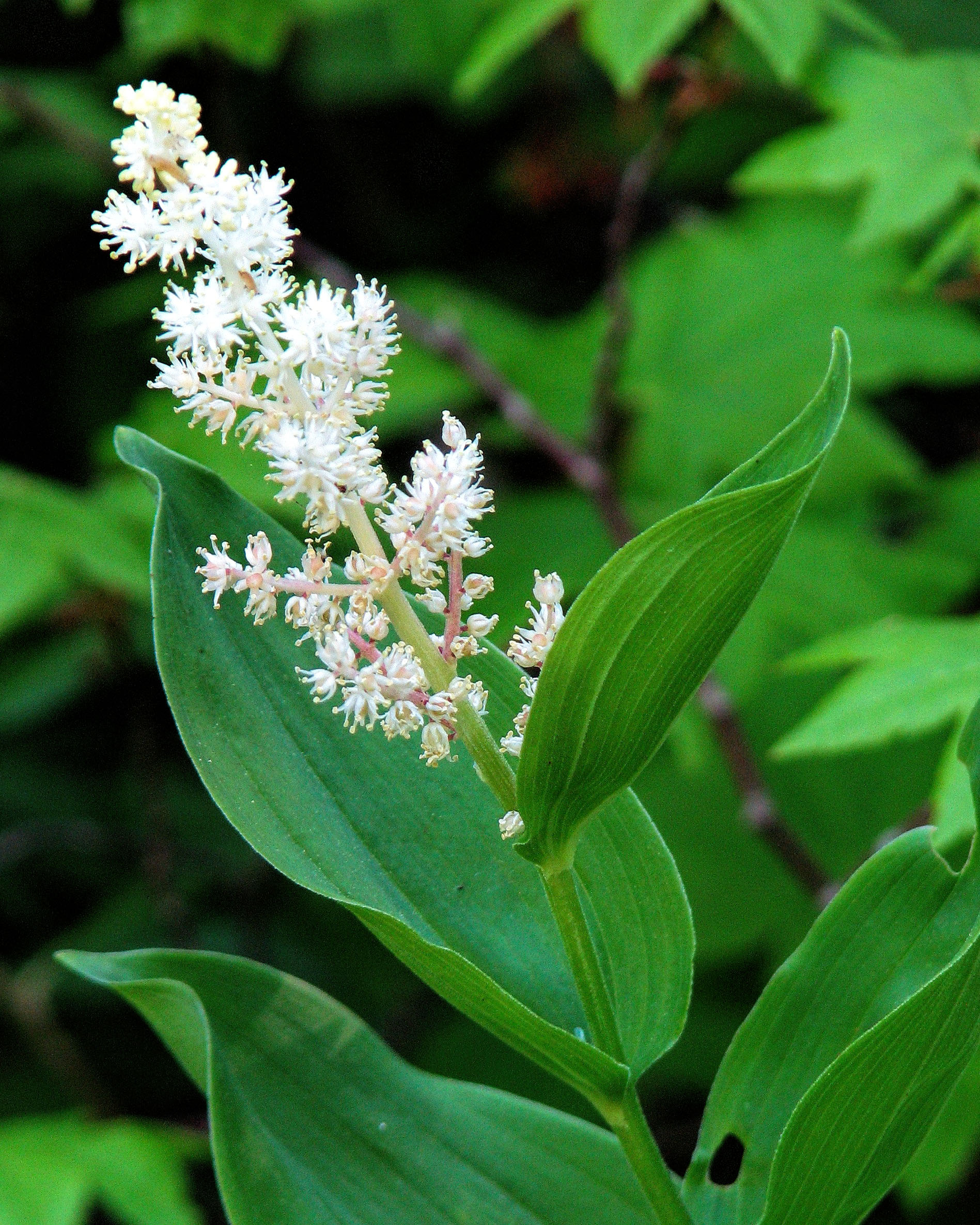
There is a lot of leaf similarity between the species, but the flowers are quite different. Maianthemum racemosum is a perennial twelve to thirty-seven inches found only on the west side of the Cascades and other western mountain ranges. The plants form spreading clumps from rhizomes. The stem is erect, unbranched and usually arching. The leaves are alternate in arrangement, sessile (arising right out of stem) or clasping the stem, oblong in shape with pointed tips, three to eight inches long, smooth above. The inflorescence terminates the stem with showy clusters of twenty plus flowers. The flowers are small, white in a tight panicle that is two to five inches long. Fruits are berries green with brown mottling turning red with maturity. One would find the plants in moist forests as a understory groundcover.

four up collage of three false solomon's seal flowers and one photo of green berries.
L-R; T-B: Star False Solomon’s Seal (Maianthemum stellatum), berries on a Maianthemum, False Lily of the Valley (M. dilatatum), Large False Solomon’s Seal (M. Stellatum). Photos by Dr. F. Alice LeDuc

Maianthemum stellatum is a perennial one to two feet tall. The stem upright, unbranched arching above. Stems can be straight or zigzag between leaves. The leaves are alternate sessile or clasping widely oval with pointed tips. The flowers are in a loose inflorescence, twelve or fewer, star-shaped, with individual pedicels on the terminal portion of the stem. The fruits are berries, greenish yellow turning blue or black at maturity. The habitat is moist woods and along streams. Stems are often in clumps coming form creeping roots. The leaves are heart-shaped to eight inches by four inches wide, shiny. The petioles are two to six inches long that hold the blades more or less horizontal. The flowers are fragrant, white, many in a cone-shaped inflorescence at tip of each stem. Unique in the lily family having floral parts in fours not threes. The fruit berry in fall light green and brown mottles turning red at maturity. The plants are found in moist shady sites at low elevations.

Historically the Indigenous people of the Pacific Northwest found uses for Maianthemum stellatum and M. dilatatum using the roots and leaves medicinally as poultices for wounds, minor burns and sore eyes. M. dilatatum berries were used to treat tuberculosis. In addition, they consumed shoots and processed roots of M. stellatum. Occasionally the berries of M. dilatatum were also eaten.

Today these plants are extremely useful as shade loving groundcover. So, whether you enjoy them as part of your landscape or just find joy in seeing them while out walking or hiking let them bring you happiness.

I know that I sometimes use the plant common names and at times I use the scientific names. I usually use common names when they are simple, but when the common names have several words in them I defer to the scientific name as easier to read in context.